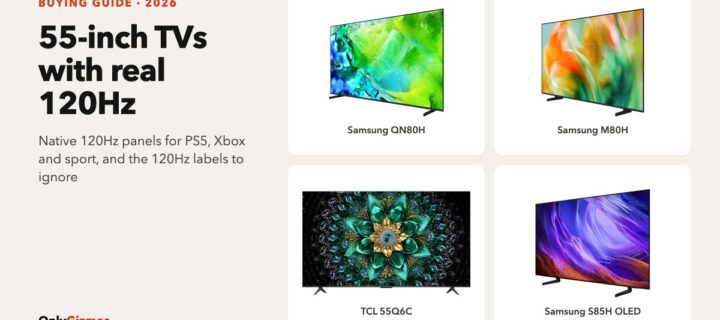
Search Amazon for a 55-inch 120Hz TV and most of the results are 60Hz sets wearing a 120Hz badge. “120Hz Game Booster”, “DLG 120Hz”, “Motion Xcelerator” and “120Hz MEMC” all sound like the real thing. None of them gives a PS5 or Xbox Series X a true 4K 120 picture.
So this list has one entry rule: the maker’s own spec sheet for the exact 55-inch Indian model must show a panel that refreshes at least 120 times a second. Several TVs pass; these are the seven in stock that we’d buy. We rank them for gamers, add a note for sports fans, and name the popular look-alikes that don’t pass.
What actually matters when buying
The panel’s native refresh rate, at your size. A native 120Hz panel draws 120 full 4K frames a second. DLG and HSR modes reach “120Hz” by halving the vertical resolution of a 60Hz panel, and MEMC or “motion rate” figures are image processing, not refresh. Size matters too: some brands advertise 144Hz for a whole range when the 55-inch is a 120Hz panel.
HDMI inputs that actually carry 4K 120. A console needs an HDMI 2.1 input that accepts 4K at 120Hz, plus an Ultra High Speed HDMI cable (the one in the PS5 box works). Some TVs give you four such inputs. Others give you two out of four, and the soundbar’s eARC input may be one of them. If you own two consoles or a gaming PC, the port count decides the TV.
VRR and ALLM. Variable refresh rate (VRR, including AMD FreeSync) lets the TV follow the game’s frame rate, so a game wobbling between 70 and 110 fps doesn’t tear or stutter. ALLM switches the TV into its low-lag game mode automatically when the console starts. All seven picks support VRR.
120Hz or 144Hz? PS5 and Xbox Series X top out at 120Hz, so 144Hz only matters if you also connect a gaming PC. Don’t pay extra for a bigger number if a console is all you own.
Picture type, as a tie-breaker. Mini LED gets brighter and suits sunny living rooms. OLED lights each pixel on its own, which gives the cleanest contrast and motion in a dim room. Dolby Vision support varies by brand; Samsung doesn’t offer it.
If you don’t game or watch much fast sport, you don’t need 120Hz at all. Our 55-inch 4K TVs under Rs 60000 guide covers that buyer for less.
Quick answer
- Our pick: Samsung QN80H, around Rs 88,000. Rated 144Hz with VRR, and all four HDMI inputs take 4K 144, so a PS5, an Xbox and a soundbar plug in without any port puzzles. The catch: it’s Rs 24,000 more than the M80H.
- Best value: Samsung M80H, around Rs 64,000. The same 144Hz rating, Mini LED and FreeSync Premium for much less. Watch for: three HDMI inputs, and which of them carry 4K 120 isn’t published.
- Cheapest real 120Hz: TCL 55Q6C, around Rs 60,000. QD-Mini LED, 40W sound and a genuine 120Hz panel at 55 inches. The downside: it’s 120Hz, not the 144Hz in the ads, and its one-star share is high.
- Most hardware for the money: Toshiba 55Z670SP, around Rs 65,000. A 120Hz panel with 4K VRR up to 144Hz, 128 dimming zones, four HDMI inputs and 54W of speakers. Mind: VIDAA instead of Google TV or Tizen, and only two of the four inputs are HDMI 2.1.
Spending more? The TCL 55C7L (around Rs 99,000) is the bright-room pick, the Samsung S85H (around Rs 1.03 lakh) is the OLED to buy, and the Sony Bravia 5 (around Rs 1.17 lakh) is for Sony loyalists.
In this guide
- Is it really 120Hz? How to read the label
- What the extra money buys
- Samsung QN80H
- Samsung M80H
- TCL 55Q6C
- Toshiba 55Z670SP
- TCL 55C7L
- Samsung S85H
- Sony Bravia 5
- What owners report
- Check the model code before you pay
- Other models we considered
- FAQ
- Which one should you buy?
| Model | Price | Best for |
|---|---|---|
| Samsung QN80H | Rs 88,000 | Two consoles, no port juggling |
| Samsung M80H | Rs 64,000 | 144Hz rating for less |
| TCL 55Q6C | Rs 60,000 | Lowest price for real 120Hz |
| Toshiba 55Z670SP | Rs 65,000 | Ports, dimming zones, sound |
| TCL 55C7L | Rs 99,000 | Bright rooms, PC gaming |
| Samsung S85H | Rs 1.03 lakh | OLED contrast and motion |
| Sony Bravia 5 | Rs 1.17 lakh | Sony picture and Google TV |
Is it really 120Hz? How to read the label
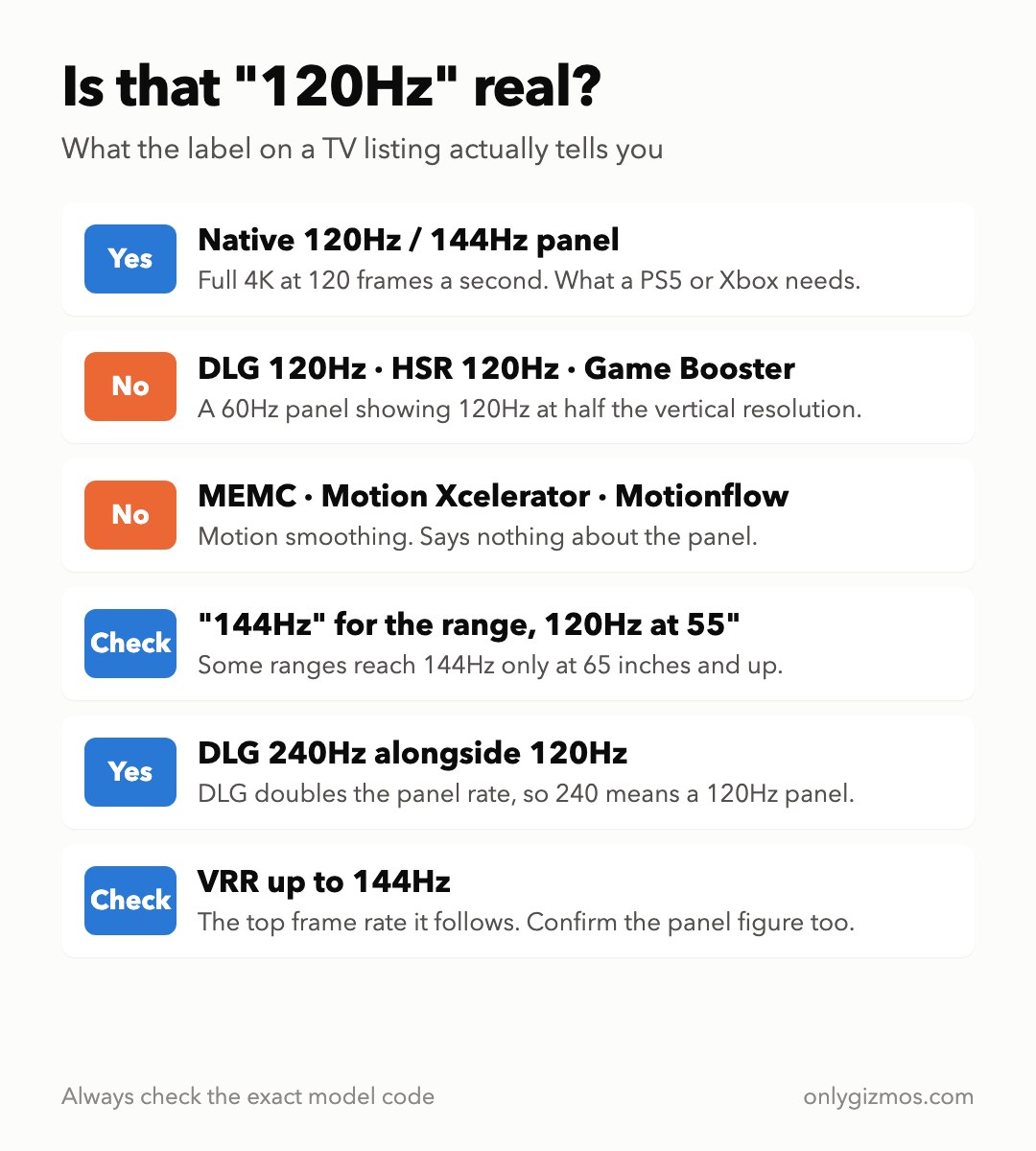
Listings mix four different things under “120Hz”. Here’s how to tell them apart.
- Native 120Hz or 144Hz. The panel itself refreshes that fast at full 4K. This is the only one that matters for a console.
- DLG, HSR or “Game Booster”. The TV doubles its refresh by halving vertical resolution. A “DLG 120Hz” figure means a 60Hz panel; “DLG 240Hz” means a 120Hz panel. Resolution drops in this mode.
- MEMC, Motion Xcelerator, Motionflow XR, TruMotion. Motion smoothing that invents in-between frames. Useful for sport, but it says nothing about the panel.
- VRR up to 144Hz. It’s the top of the VRR range, not the panel’s native rate: a 120Hz panel can still list VRR to 144.
Some of the best-selling “120Hz” listings fail the test. Every Indian 55-inch Xiaomi, including the FX Pro and X Pro sold with “120Hz Game Booster”, is a 60Hz panel with DLG. LG’s 55NU880BPLA is sold on Amazon as “120Hz Native”, but it’s a 60Hz panel. Samsung has look-alikes too; see the model-code check further down.
What the extra money buys
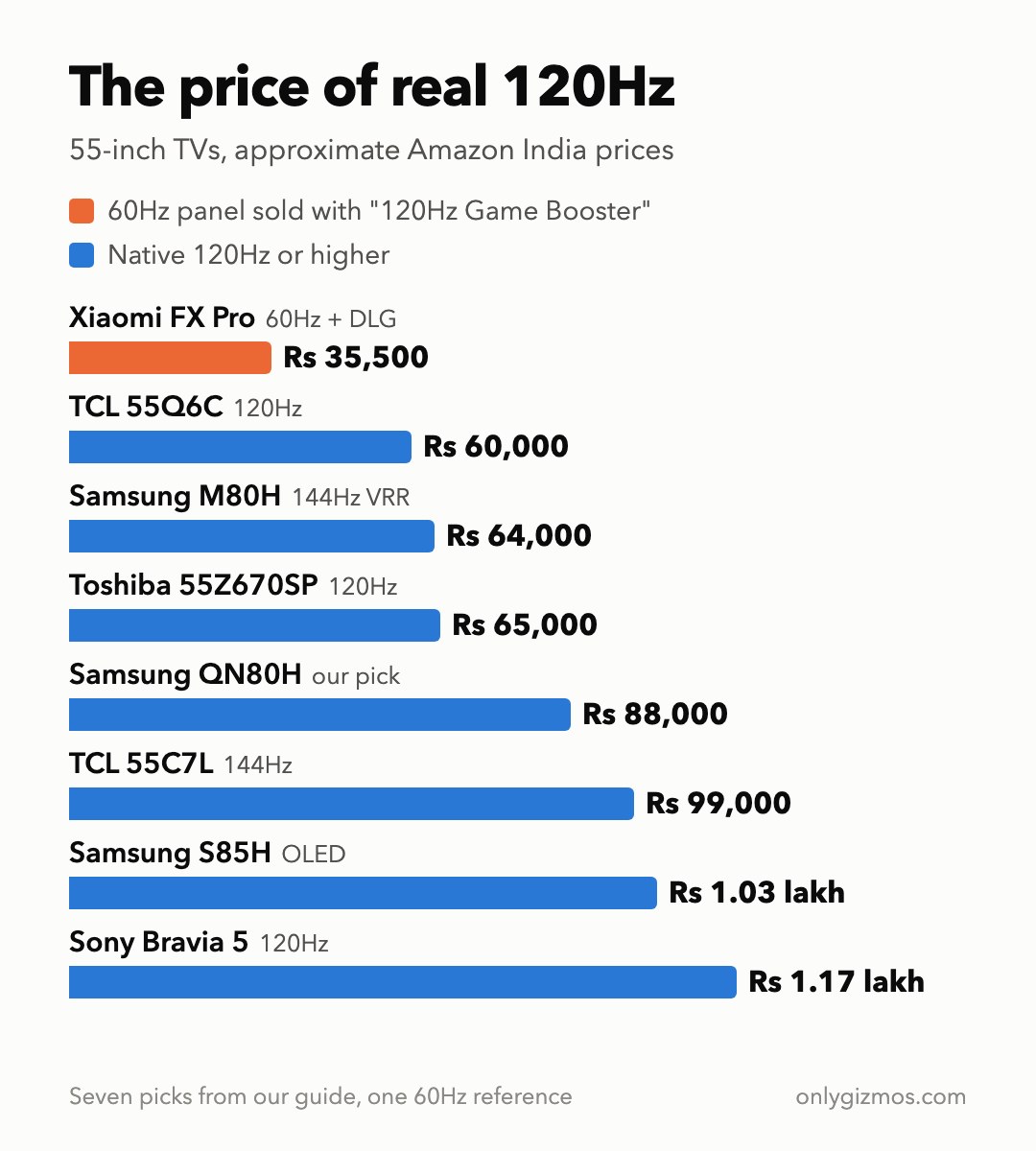
The cheapest genuine 120Hz set on Amazon today, the TCL 55Q6C at about Rs 60,000, costs roughly Rs 24,500 more than Xiaomi’s 60Hz FX Pro. That gap buys a real 120Hz panel and Mini LED. On sale, the Q6C can cost little more than the 60Hz Xiaomi.
From there, each step up buys something specific:
- Rs 4,000 more (Samsung M80H): Samsung’s service network, Tizen and a 144Hz VRR rating.
- Another Rs 1,000 (Toshiba 55Z670SP): a fourth HDMI input, 128 dimming zones and 54W of sound.
- Rs 24,000 over the M80H (Samsung QN80H): a fourth HDMI input and 4K 144 confirmed on all four.
- About Rs 15,500 over the QN80H (Samsung S85H): OLED.
Why 120Hz at all? At 60Hz each frame stays on screen for 16.7 milliseconds. At 120Hz it’s 8.3 milliseconds. In a game that runs at 120 fps, that means smoother camera pans and a quicker response to your controller.
Samsung QN80H: Our pick
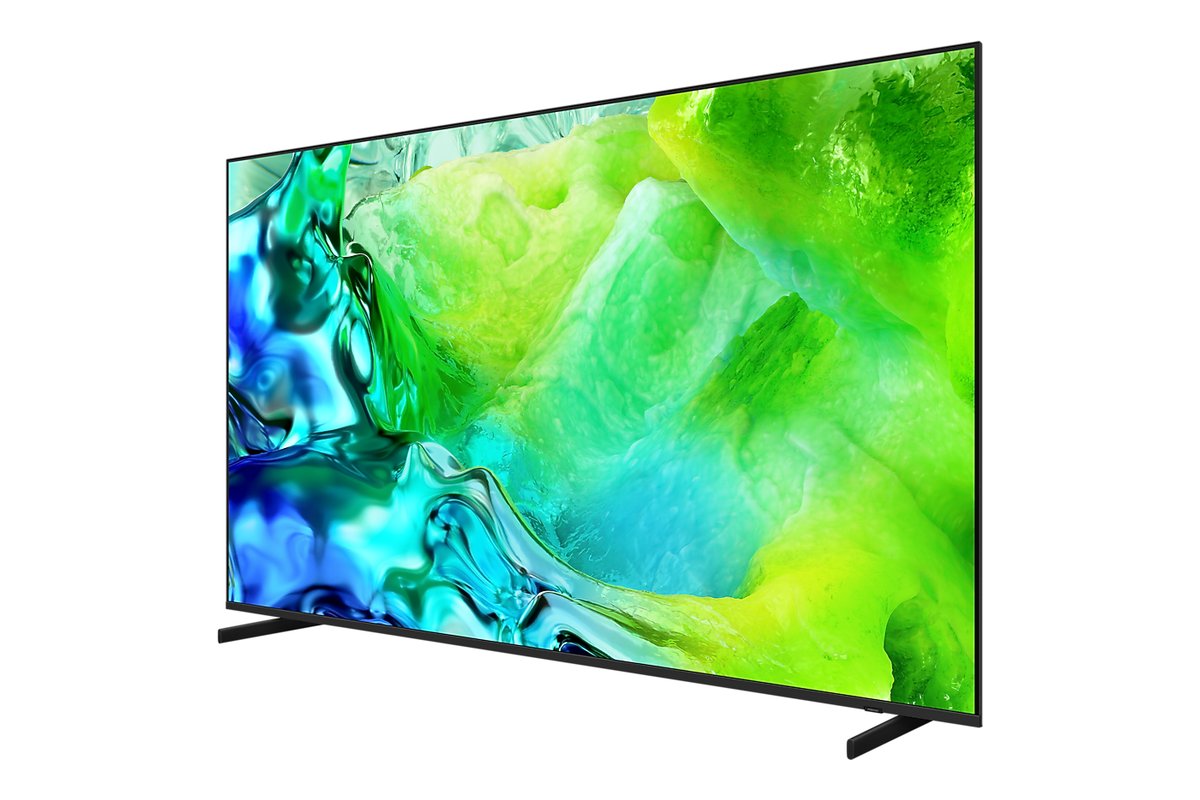
The QN80H (QA55QN80HAULXL) is the TV we’d buy for a console. It’s rated 144Hz with VRR, and all four HDMI inputs take 4K 144. That’s the clearest answer to the port question of any TV here. Plug in a PS5, an Xbox and a gaming PC, put the soundbar on eARC, and every device still gets a full-speed input.
Around that, it’s a strong all-rounder. It’s a Neo QLED with Mini LED local dimming, which keeps dark scenes darker. It supports FreeSync Premium Pro, ALLM and HGiG (so HDR games look as the developer intended), and runs Tizen.
The compromises are small for a gamer but real. The speakers are 30W, so budget for a soundbar if sound matters. And if you own one console, the M80H gets you most of this for Rs 24,000 less.
It’s a 2026 model with only a couple of Amazon ratings so far, so there’s no owner track record yet.
Samsung M80H: Best value
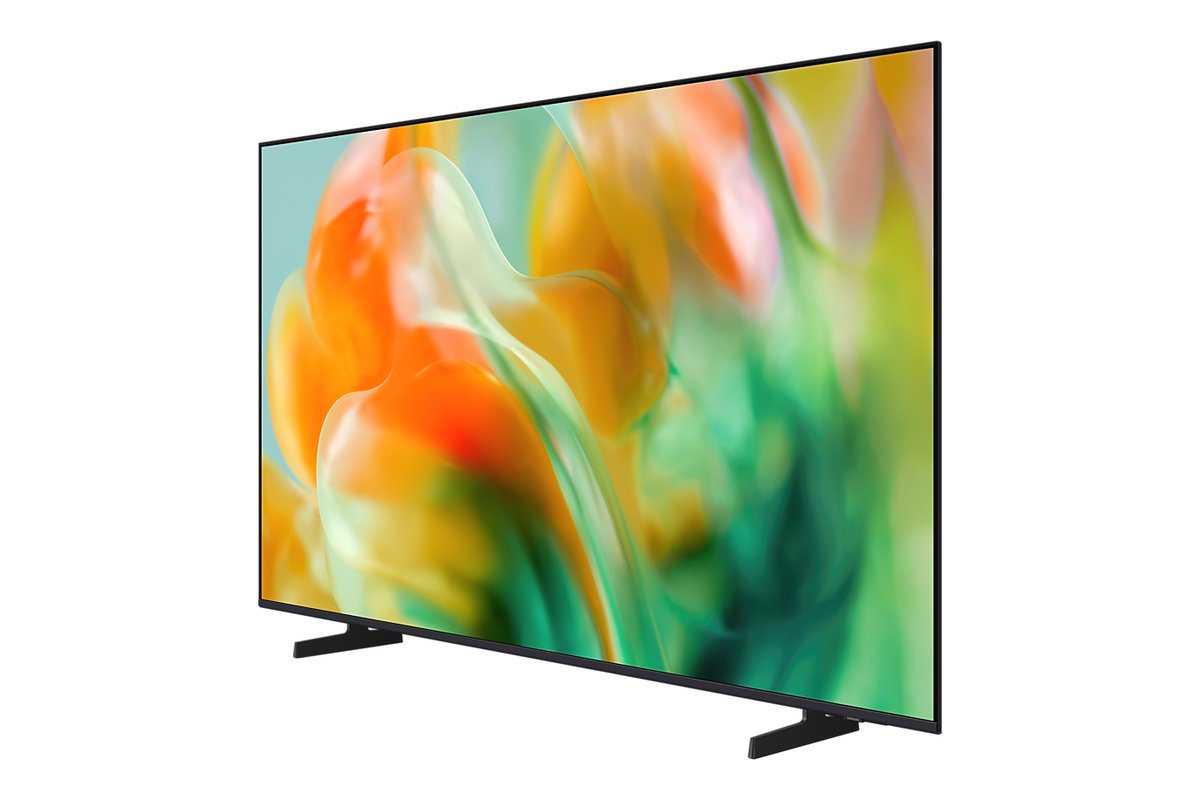
The M80H (UA55M80HAULXL) carries the same 144Hz VRR rating as the QN80H for about Rs 64,000. You get Mini LED, FreeSync Premium, ALLM, 30W of sound and Tizen. For one console, a set-top box and a soundbar, that’s everything a 120Hz buyer needs.
Two things keep it below the QN80H. It has three HDMI inputs, not four. And which of them carry 4K 120 isn’t published for this model. Before you mount the TV, check the port labels and plug the console into the one marked for 4K 120 or HDMI 2.1.
The bigger risk is buying the wrong M: the M70H and M2EH look almost identical, are 60Hz-class DLG sets, and their pages even carry a “144Hz (M80H)” banner.
TCL 55Q6C: The cheapest real 120Hz
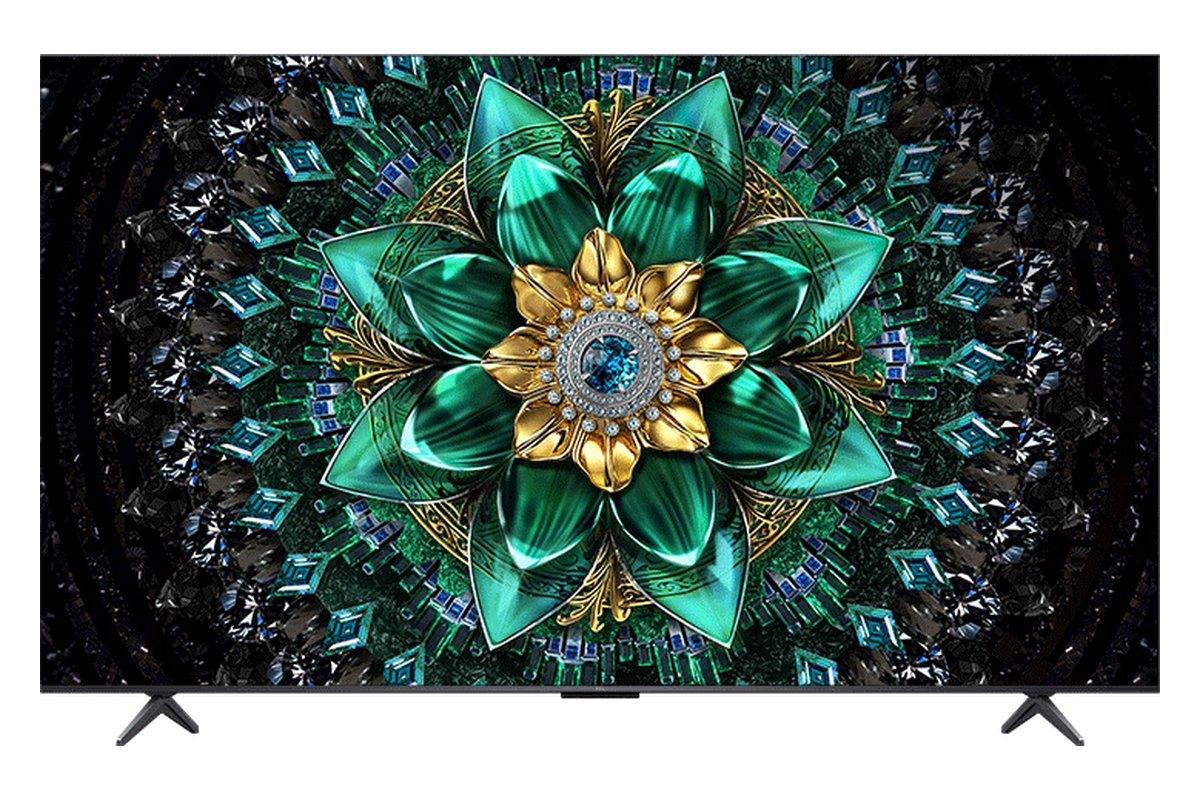
The 55Q6C, at around Rs 60,000, is the least you can spend on Amazon today for a genuine 120Hz 55-inch panel. It also brings QD-Mini LED, Dolby Vision IQ, Google TV and a 40W 2.1-channel speaker system, more output than any Samsung here.
Be clear about what you’re getting. It’s sold as a 144Hz TV, but the 55-inch is a 120Hz panel (its 240Hz figure is a DLG mode); only the 65 and 75-inch are 144Hz. For a PS5 or Xbox that makes no difference, since both stop at 120Hz. It does matter if you planned to run a PC at 144.
The other caution is reliability. 15% of the listing’s 1,816 ratings are one-star. That count pools the 55, 65 and 75-inch sizes, and a buyer of the 65-inch says the screen died within two months. Inspect the panel at installation and keep the box until the TV has run for a week.
Its price swings a lot: owners report paying Rs 35,000 to Rs 40,000 in sales. At that price it’s an easy recommendation; at Rs 60,000 the Samsung M80H is only Rs 4,000 more.
Toshiba 55Z670SP: Most hardware for the money
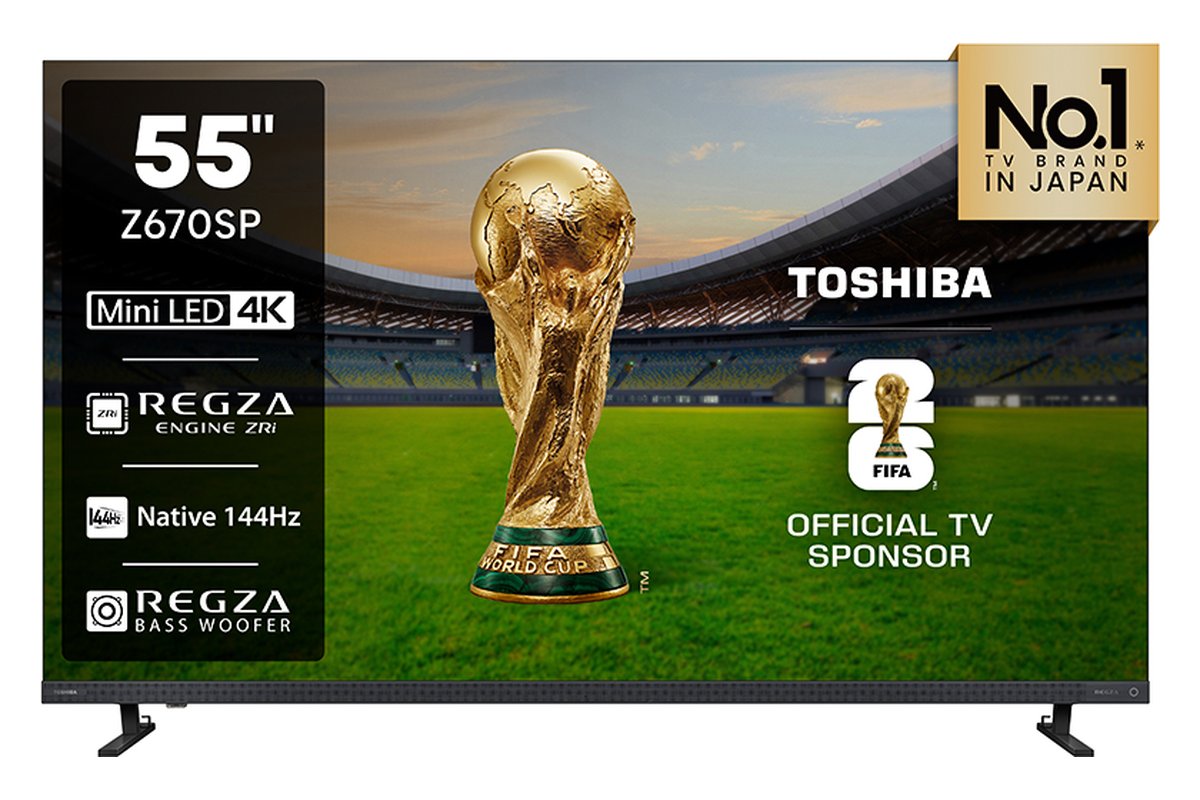
On paper, the 55Z670SP gives you the most for about Rs 65,000. It has a Mini LED QLED panel with 128 local dimming zones and a 120Hz image refresh rate, with VRR running from 48 to 144Hz at 4K. It supports FreeSync Premium, and four front-firing speakers deliver 54W.
Its port layout is the most sensible of the mid-priced picks. There are four HDMI inputs. HDMI 3 and 4 are HDMI 2.1, and eARC sits separately on HDMI 2. Two consoles take 3 and 4, the soundbar takes 2, and nothing shares.
Ignore the “Native 144Hz” headline: treat it as a 120Hz TV that can follow a PC up to 144. The apps run on VIDAA rather than Google TV, so confirm the apps you rely on are available.
Toshiba 55Z670SP on Amazon India
TCL 55C7L: For bright rooms
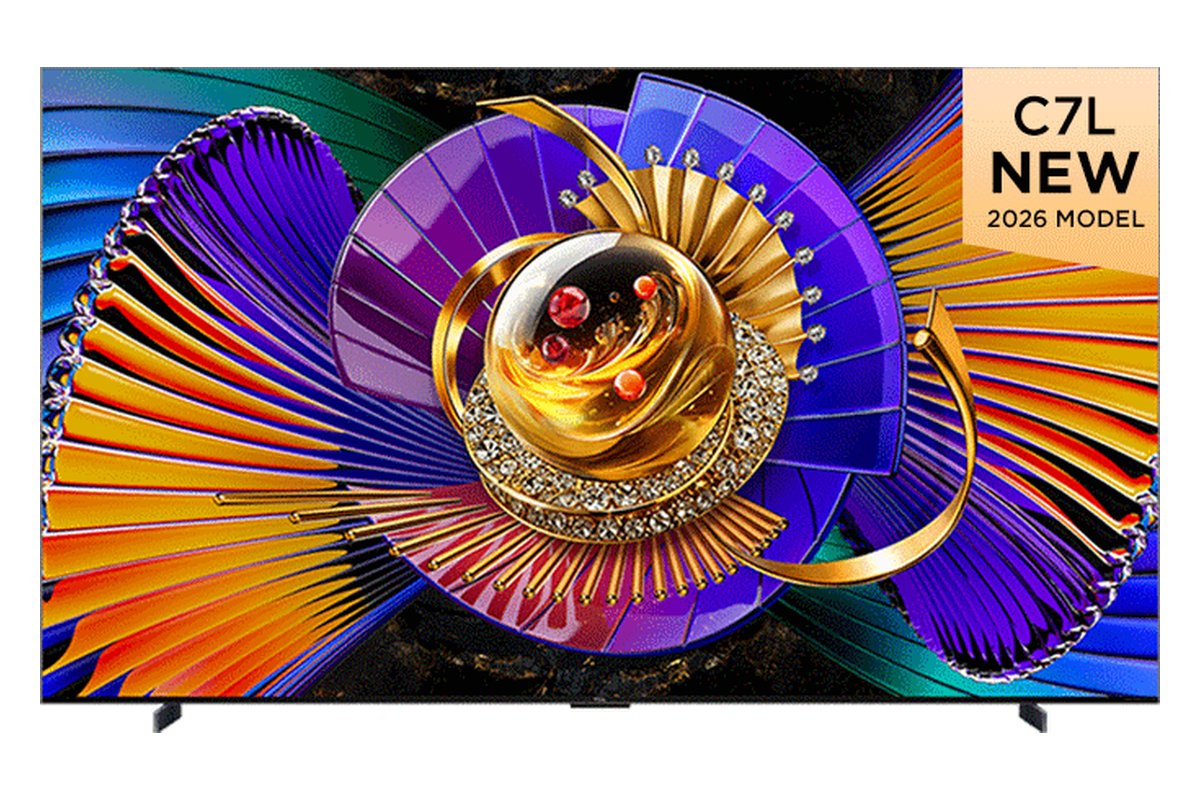
The 55C7L is the only pick with a native 144Hz panel at 55 inches, and the only one with a published peak brightness: 2,700 nits from its SQD-Mini LED backlight. That matters in a sunlit living room or for HDR games with bright skies. Sound is by Bang & Olufsen, and it runs Google TV with Dolby Vision IQ.
The “288Hz VRR” on the Amazon listing is a reduced-resolution DLG mode for PC games, and it works only on HDMI 1 and 2, so put a gaming PC on one of those.
Priced around Rs 99,000, it’s about Rs 11,000 more than the Samsung QN80H. Pay it for the brightness and the 144Hz panel if you game on a PC. For a console in a normal room, the Samsung is the safer buy. The C7L has only 21 Amazon ratings, 15% of them one-star, so it’s too early to judge reliability.
Samsung S85H: The OLED pick
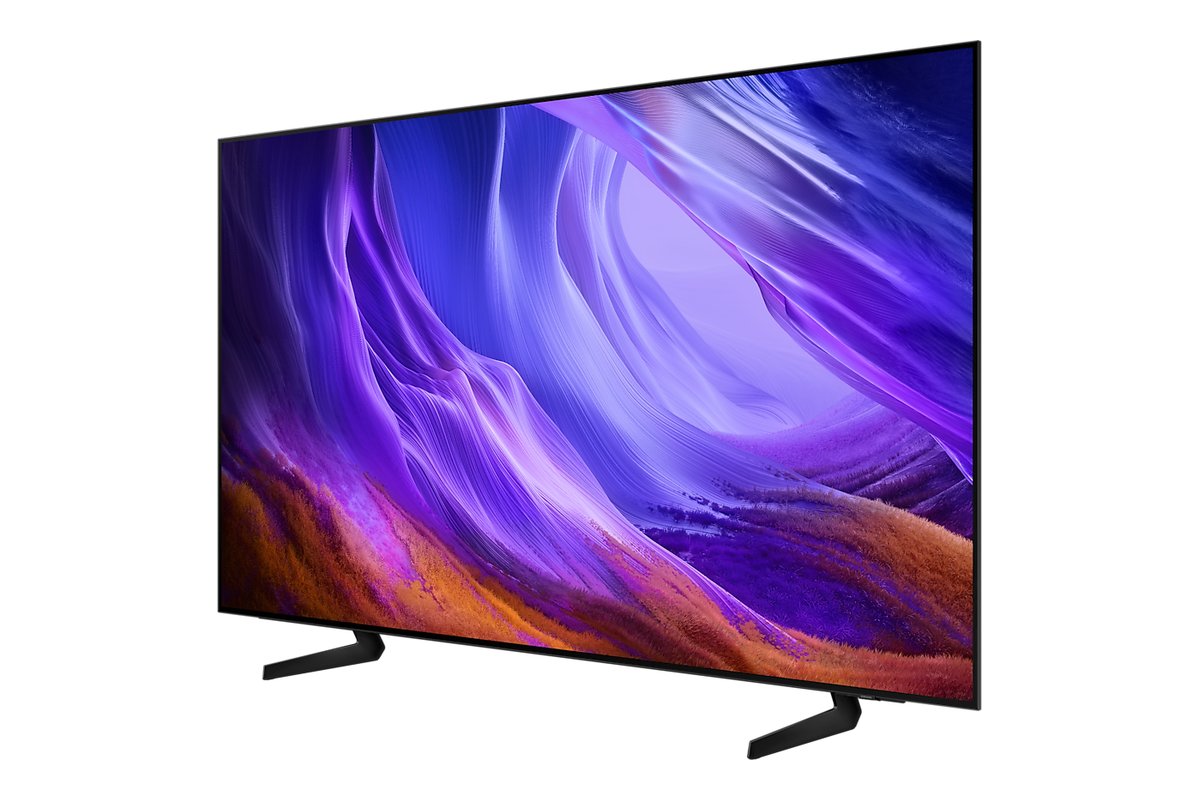
If you play mostly in the evening, or watch football with the lights down, the S85H (QA55S85HAELXL) is the one. OLED lights every pixel on its own, so dark scenes stay black without the glow that can surround bright objects on an LED TV. It refreshes at 120Hz with VRR, supports FreeSync Premium, G-Sync Compatible and ALLM, and has four HDMI inputs.
The speakers are 20W, and which inputs take 4K 120 isn’t published for this model, so check the port labels as you would on the M80H.
At around Rs 1.03 lakh it’s about Rs 15,500 more than the QN80H.
Sony Bravia 5: For Sony loyalists
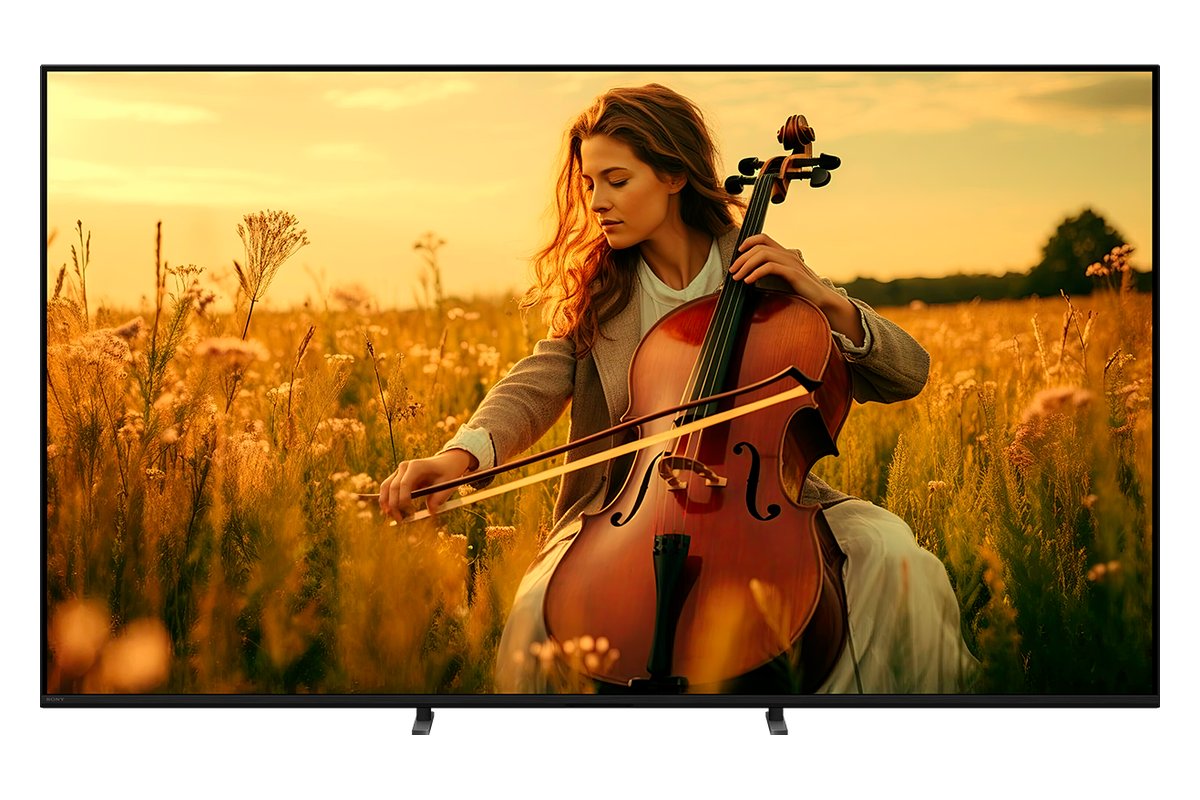
The Bravia 5 (K-55XR50) is a 120Hz Mini LED TV with local dimming, Google TV, Dolby Vision and a 40W speaker system. If your household prefers Sony, this is the 55-inch Sony we’d buy for gaming.
The port layout is the weak point for gamers. Only HDMI 3 and HDMI 4 handle 4K 120 and VRR, and you have to switch those inputs to Sony’s enhanced HDMI format first. That’s fine for one console. Whether the eARC port is one of those two isn’t published, so two consoles plus an eARC soundbar may not all get full speed.
It’s also expensive for what it does. At around Rs 1.17 lakh it costs Rs 29,000 more than the Samsung QN80H. Two Amazon owners find it dimmer than they’d like. Buy it if you want Sony; otherwise the QN80H is the better gaming TV for less.
What owners report
Most of these TVs are too new for a long track record, and some Amazon ratings mislead because they’re pooled. Besides the TCL 55Q6C’s mixed sizes, the Toshiba’s ratings mix several Z-series models, and the Samsung S85H shares its ratings with the S90H. Read reviews for the exact size and model code.
A few reports are worth knowing. A Q6C owner noticed judder in cricket and fixed it in the motion settings, so try those before you blame the panel. Commenters on a popular YouTube TV comparison worry about Sony’s and TCL’s service reach. And Toshiba installation can take time: one buyer waited 12 days. Check service coverage for your PIN code before you order any of these.
Check the model code before you pay
One letter or one numeral changes the refresh rate in this category, and look-alikes sit side by side on Amazon:
- Samsung M80H (UA55M80HAULXL) is 144Hz-rated. The M70H and M2EH are DLG 120 on a 60Hz-class panel.
- Samsung QN80H is 144Hz-rated. The QN70H is DLG 120, despite “144Hz” in its page’s FAQ.
- TCL 55Q6C is 120Hz. The 55Q6CS is a 60Hz panel.
- Sony Bravia 3 II (K-55XR35M2 and K-55XR30M2) is native 120Hz. The older Bravia 3 (K-55S30) and the Bravia 2 II are 50Hz.
- LG 55QNED82BLA (2026) is 120Hz native. The 2024 55QNED82T6A is 60Hz.
Other models we considered
Sony Bravia 3 II (K-55XR35M2), around Rs 90,000. A genuine 120Hz panel with VRR on all four HDMI inputs. But it’s direct LED with frame dimming rather than local dimming, and the speakers are 20W. The Samsung QN80H is better hardware for Rs 2,000 less.
Samsung S90H (QA55S90HAULXL), around Rs 1.3 lakh. An OLED rated 165Hz with VRR. Consoles can’t use more than 120Hz, so for gaming the S85H gets you most of the way for Rs 26,500 less.
LG QNED82 (55QNED82BLA) and LG C6 OLED (OLED55C6PLA). Both are native 120Hz with 4K 120 on every HDMI input, which makes the C6 one of the best-documented gaming TVs on sale. Both are unavailable on Amazon right now. On LG’s own store they’re priced around Rs 63,000 and Rs 1.6 lakh, but check stock before you count on either.
Hisense 55E8S. A 144Hz Mini LED with four HDMI inputs, but it’s out of stock on Amazon.
TCL 55T8D. The default pick in our under Rs 60000 guide has a 144Hz panel, but it’s currently unavailable.
Need more inputs than gaming ports, for a set-top box, streamer and console all at once? See our TVs with multiple HDMI ports page.
FAQ
Is “120Hz Game Booster” real 120Hz? No. It’s DLG: the TV halves its vertical resolution to show 120 frames on a 60Hz panel. On these TVs a console’s 120Hz modes run at a lower resolution, if at all, never at 4K 120.
What do I need for 4K 120 on a PS5? A TV with native 120Hz and an HDMI 2.1 input that accepts 4K 120, the HDMI cable from the PS5 box (or any Ultra High Speed cable), 120Hz output switched on in the PS5’s video settings, and a game that supports it. Some TVs, including Sony’s, need the input set to an enhanced HDMI format first.
Is 144Hz better than 120Hz for gaming? Only on a PC. PS5 and Xbox Series X stop at 120Hz, so a 144Hz TV and a 120Hz TV look the same with a console.
Does 120Hz help cricket and football? A little. Broadcasts and streams don’t carry 120 frames a second, so a 120Hz panel can’t show extra real frames. What it gives the TV is room for smoother motion processing. If players start to look unnaturally smooth, turn the motion setting down.
Can a 60Hz TV do VRR and ALLM? Yes, many do: VRR up to 60Hz and automatic game mode. That helps games that run below 60 fps, but you won’t get 120 fps modes.
OLED or Mini LED for gaming? OLED for dark-room contrast and the cleanest motion. Mini LED for bright rooms and lower prices. Both work well at 120Hz.
Which one should you buy?
Buy the Samsung QN80H. It’s the 55-inch 120Hz TV with no port catches for a gamer: 144Hz VRR, and 4K 144 on all four HDMI inputs, so it handles whatever you plug in next year.
If you own one console and want to keep about Rs 24,000, buy the Samsung M80H and check its port labels. Want more speakers and dimming zones for the same money, and happy with VIDAA? The Toshiba 55Z670SP is the alternative. And if a sale brings the TCL 55Q6C back near Rs 40,000, grab it.
Spend more only for a reason: the TCL 55C7L for a bright room or a 144Hz PC, the Samsung S85H for OLED, or the Sony Bravia 5 because you want a Sony. For cricket and football, any of these works; turn motion smoothing down if players look too smooth. Whatever you choose, check the model code against the list above before you pay.
Last updated: October 2026