
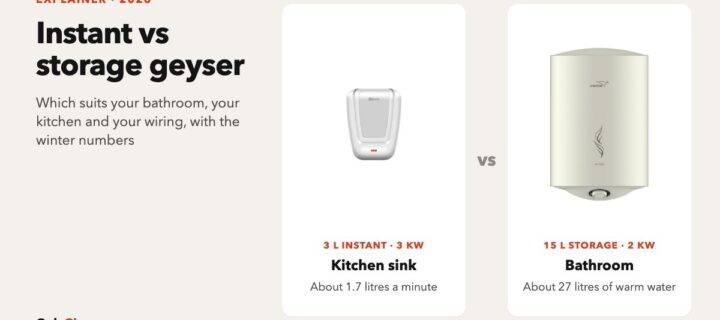
For a bathroom, buy a storage geyser: 15 litres if one to three people take bucket baths spread over the morning, 25 litres for a bigger family or a short shower. Keep the instant geyser for the kitchen sink or wash basin. A 3 kW instant warms about 1.7 litres a minute from 15 C tap water, and only 1.4 in a Delhi January, so a bucket takes ten to thirteen minutes and a shower is out of reach.
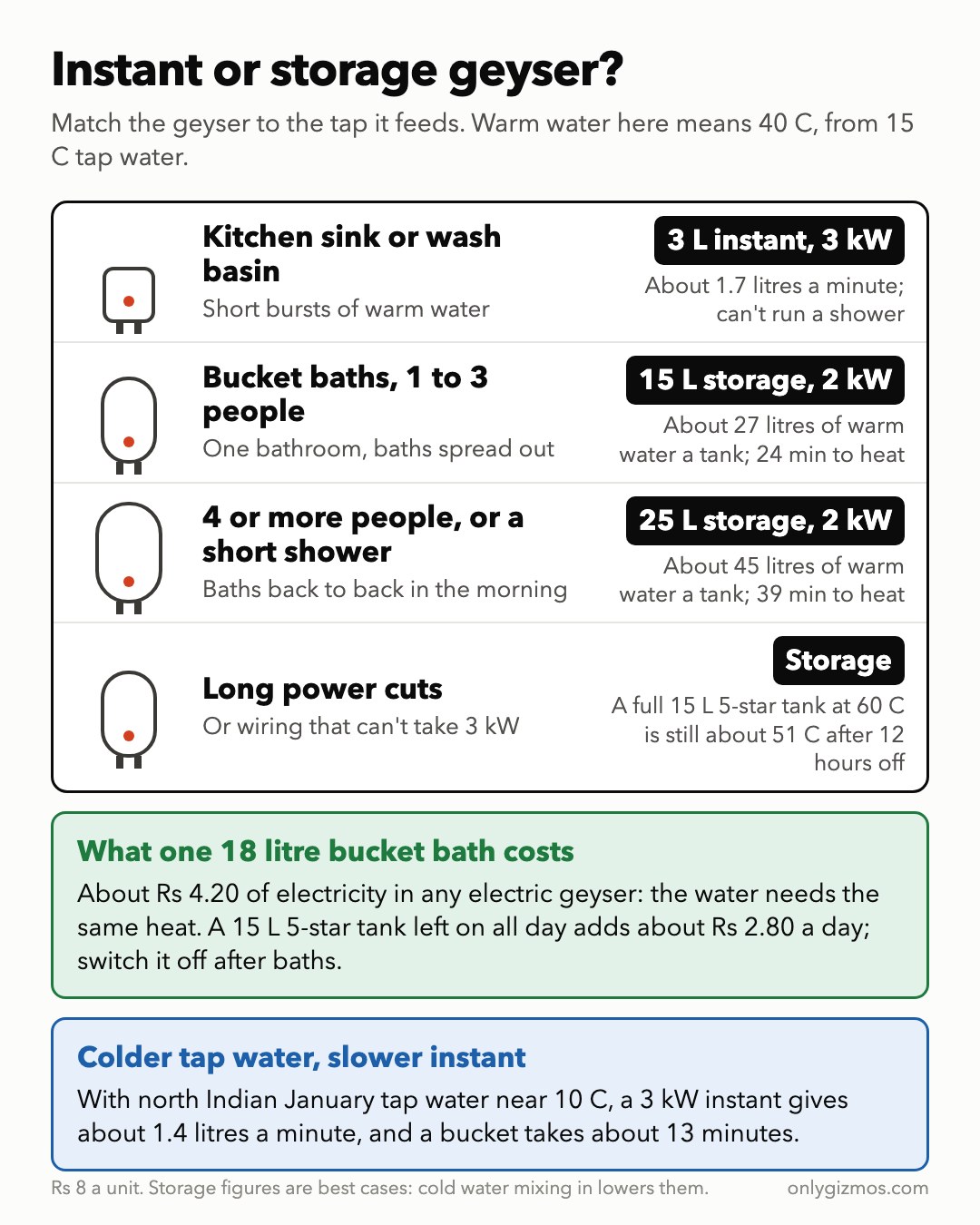
Electricity is not what separates them. Heating a bucket of water costs the same in either type; what differs is how much warm water you get at once, how your wiring copes, and what happens when the power goes. Here is the decision by situation, with the numbers behind it. If you already know which type you need, go straight to our geysers for home guide for ranked picks.
| If this is you | Buy | Why |
|---|---|---|
| Kitchen sink or basin | 3 L instant | Cheap; warm water in a minute or two |
| Bucket baths, 1 to 3 people | 15 L storage | One bath per tank, 24 min reheat |
| 4 or more, or a short shower | 25 L storage | Two baths, or a short shower |
| Long power cuts | Storage | Tank stays hot for hours |
| Hard borewell water | Storage, glass-lined | Lining and anode resist corrosion |
Instant vs storage geyser: what is actually different
The “instant geyser” sold in India is not a tankless heater. It is a small tank, usually 3 litres, with a 3,000 W element. The water in that tank heats in a few minutes, and once you have used it, the element warms fresh water as it flows past. A storage geyser for a bathroom holds 15 or 25 litres behind insulation and heats it with a 2,000 W element, then keeps it hot until you need it.
Everything else follows from those numbers. Heating water takes a fixed amount of energy per litre per degree, so a 3 kW element can only add so much heat a minute. Raise water from 15 C to a comfortable 40 C and 3 kW manages about 1.7 litres a minute. A storage tank at 60 C, mixed with cold tap water to 40 C, gives about 27 litres from 15 litres and about 45 from 25. Those storage figures are best cases, because cold water flows in as you draw hot.
The price gap is real but modest. The cheapest storage example below costs about Rs 3,600 more than the cheapest instant, and going from 15 to 25 litres adds only Rs 900 to Rs 1,250.
Instant vs storage geyser for bathroom
A bucket bath uses roughly 18 litres. From a 3 kW instant that bucket takes about ten minutes to fill at 40 C, longer in a north Indian winter. Most people won’t wait that long twice. A 15 litre storage geyser fills the same bucket as fast as the tap runs and still has warm water to spare.
A shower is a harder test. A Jaquar overhead shower is rated at 11.5 to 16.6 litres a minute at 3 bar, and even fitted with Jaquar’s smallest 6 litre flow regulator it needs over three times what a 3 kW instant can warm. Turn the mixer towards hot and the water simply runs lukewarm. One owner of a 5 litre Havells instant reports hot water running out three to four minutes into a shower. Storage helps only so much: the 45 litres from a 25 litre tank last about seven and a half minutes through a 6 litre regulator, and three to four minutes at full flow.
Family size and the morning rush. Two people back to back is about the limit for 15 litres: one full bucket and most of a second. Three is fine if baths are spread over the morning, since a 15 litre tank reheats from cold in about 24 minutes. Four or more before 9 am need 25 litres, baths spaced to allow its 39 minute reheat, or a second geyser. If you are adding geysers to guest bathrooms before a wedding, the same rule applies: guests bathe in a rush, so give each bathroom used for baths a 15 litre storage geyser and keep instants for basins.
Instant vs storage geyser for kitchen
At the kitchen sink you want warm water in short bursts for greasy vessels, and a 3 litre instant does that well. The first few litres come out hot from the tank; after that the water cools unless you turn the tap down to the rate the element can keep up with. It costs about Rs 2,900 to Rs 3,000, under half the price of a 15 litre storage geyser. A storage geyser in the kitchen is overkill unless it also feeds a bathroom on the same line.
Winter tap water changes the answer
The colder your tap water, the slower an instant gets, because every litre needs a bigger temperature rise.
| Winter tap water | Typical of | 3 kW instant at 40 C |
|---|---|---|
| About 10 C | Delhi, Lucknow, Chandigarh | 1.4 L a minute; bucket in 13 min |
| About 15 C | Kolkata | 1.7 L a minute; bucket in 10 min |
| About 20 C | Bengaluru | 2.2 L a minute; bucket in 8 min |
| About 25 C | Mumbai, Chennai | 2.9 L a minute; bucket in 6 min |
These tap temperatures are our assumptions, set a little above each city’s normal January night low, because a rooftop tank cools towards the night air but rarely reaches it.
In Chennai or Mumbai a 3 kW instant fills a bucket in about six minutes; in Lucknow in January it takes about thirteen. A storage geyser also takes longer to heat colder water, about 26 minutes for 15 litres from 10 C, but you wait once, before the first bath.
Power cuts and wiring
Power cuts favour storage. A full tank keeps its heat after the supply drops. Working from the standing-loss figure on a 5-star 15 litre label, a tank at 60 C in a 15 C bathroom is still about 57 C after four hours with no power and about 51 C after twelve, if nobody draws water. Each bucket you take lets cold water in, so in practice you get fewer hours, but an overnight cut rarely means a cold bath. An instant gives nothing until the power returns. Neither type can run on a typical home inverter: a popular 900 VA Luminous unit is rated for 756 watts, against 2,000 W for a storage geyser and 3,000 W for an instant.
A 3 kW instant is the harder load to wire. A 2 kW storage geyser draws about 8.7 amps at 230 volts; a 3 kW instant draws about 13. Both need a 16 amp socket or a direct connection through their own MCB, with a reliable earth, and your meter and supply wire must be able to take the load. One buyer of a 15 litre geyser spent about Rs 3,500 more than planned after the electrician replaced 2.5 sq mm wire with 4 sq mm, and one owner reports an instant geyser burning out their MCB and socket. Ask your electrician before the geyser arrives.
Hard water
Scale settles on the heating element, and the steel tank corrodes unless something stops it. The defences are a glass-lined or enamel-coated tank and a magnesium anode that corrodes instead of the tank. Every storage example below has both; instants vary. A. O. Smith’s EWS Plus has a glass-lined tank and an anode, while V-Guard’s Zio uses a stainless steel tank with no anode listed. On white-crusted borewell water, pick the lined tank.
The anode is a consumable that makers exclude from warranty, and A. O. Smith can refuse a tank claim if it was never replaced. Racold makes descaling every six months mandatory above 400 ppm hardness.
Top-floor tanks and water pressure
A geyser passes on the pressure it gets; it does not boost it. In a top-floor flat fed straight from the overhead tank, both types deliver a gentle flow that suits a bucket and frustrates a shower.
The opposite problem is too much pressure. High-rise lines and home pressure pumps push water hard, and every storage geyser we checked from six major brands is rated 8 bar for that. Instants are rated lower: V-Guard’s Zio 6 bar, Havells and Racold 6.5 bar, with A. O. Smith’s EWS Plus an exception at 8 bar. Racold tells buyers to fit a pressure-reducing valve above 6.5 bar. On a pump line, check the rating before you buy an instant.
Running cost: what one bath costs
Heating water costs the same whichever electric element does it. An 18 litre bucket at 40 C from 15 C tap water needs about 0.52 units, roughly Rs 4.20 at Rs 8 a unit, in an instant, a storage geyser or an immersion rod. From 10 C winter water it is about Rs 5.
The extra cost is standing loss: what a storage tank burns to stay hot. BEE’s label prints it as units a day, and the star bands moved up one level in July 2026.
| Storage geyser | Units a day | Left on all day |
|---|---|---|
| 15 L, 5 star | up to 0.346 | about Rs 2.80 a day |
| 15 L, 3 star | up to 0.419 | about Rs 3.35 a day |
| 25 L, 5 star | up to 0.423 | about Rs 3.40 a day |
| 25 L, 3 star | up to 0.511 | about Rs 4.10 a day |
Leave a 15 litre 5-star geyser on round the clock and you add about Rs 1,010 a year. Switch it on half an hour before baths and off after, and since the baths draw off the hot water, little heat is left to lose. A popular comment under a geyser buying video warns people off instant geysers because of the electricity they use. That gets it backwards: an instant keeps only 3 litres hot, so it has far less water to lose heat from. Its 3 kW rating matters for your wiring, not your bill.
Geyser vs immersion rod
An immersion rod puts all its heat into the bucket, so a bath costs the same Rs 4 or so, and a basic BIS-marked rod costs about Rs 500. It is also slow: most rods are 1,000 to 1,500 W, so an 18 litre bucket from 15 C takes about 21 minutes at 1,500 W.
The real cost is risk. The rod sits in open water with live parts, and Bajaj’s own advice is never to touch the water, the bucket or the rod while it is on, and to switch off at the socket before lifting it out. That is a lot to ask of children or a sleepy adult at 6 am. Like geysers, immersion rods must carry the BIS mark, so never buy one without it. A rod makes sense as a backup while the geyser is being repaired, not as the main way a family bathes.
Geyser vs heat pump water heater
A heat pump water heater works like an air conditioner in reverse: it pulls heat from the air into the water, so it needs far less electricity. Racold rates its 150 and 200 litre models at a COP of 3.8, meaning about 3.8 units of heat for every unit of electricity. On that figure an 18 litre bucket bath costs about Rs 1.10 instead of Rs 4.20.
The catch is everything else. Home heat pumps come in 80 to 400 litre sizes and need wall or floor space plus room for the unit to draw air. They also cost far more: dealers list Racold’s 200 litre model at about Rs 1 lakh, and Havells sells a 400 litre unit at about Rs 2.95 lakh. A family of four taking one bucket bath each a day saves about Rs 4,500 a year over a storage geyser, so the extra Rs 90,000 or so takes about 20 years to come back. BEE has no star label for heat pump water heaters yet. They make sense for a large joint family or a guest house; for one bathroom, a storage geyser is the sensible buy.
Which is safer?
Both types are safe when installed properly. The A. O. Smith and V-Guard models below all list the same three protections: a thermostat, a thermal cut-out that trips if the thermostat fails, and a pressure-relief or multi-function valve. The real risks sit outside the box, in undersized wiring and poor earthing. Geysers need a reliable earth connection, so a missing or loose earth wire is the first thing to fix.
Labels that mislead
- “5 star” instants. Some instants are sold as 5 star, but BEE has no star label for instant geysers at all. Only storage geysers are rated.
- Instants pictured with showers. V-Guard markets its Zio for hot showers. The flow maths above says a 3 kW unit can’t keep a shower warm.
- Old storage stars. A 15 litre geyser at 0.381 units a day was 5 star until June 2026 and is 4 star now. Compare the units figure on the label, not the badge.
Real geysers to compare
These five come from our geyser guide, where each is ranked against its rivals. Prices are Amazon India buy-box prices.
A. O. Smith EWS Plus (3 L instant)
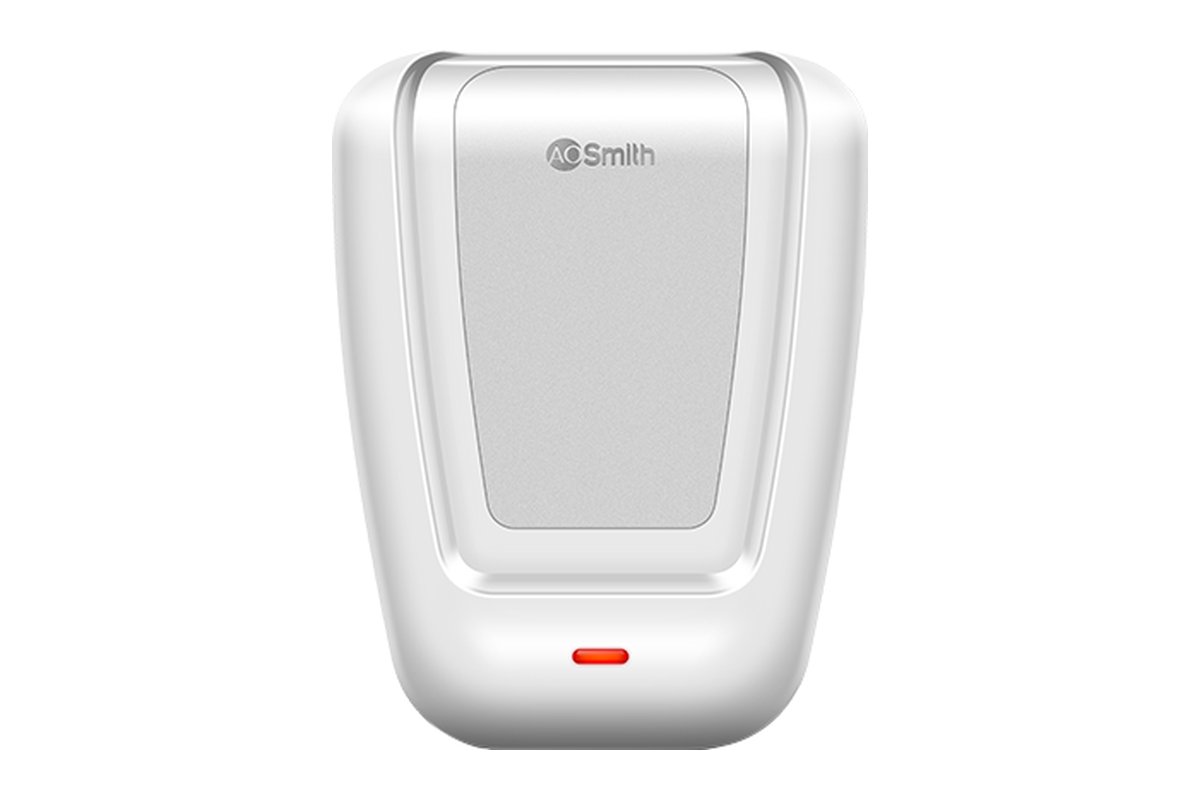
The instant to buy for a kitchen on a high-rise line or a pressure pump. It is rated 8 bar, with a glass-lined tank and an anode, and A. O. Smith covers the element for three years. The catch is 14% one-star ratings on Amazon. Expect to pay about Rs 3,000.
A. O. Smith EWS Plus on Amazon India
V-Guard Zio 3L (3 L instant)
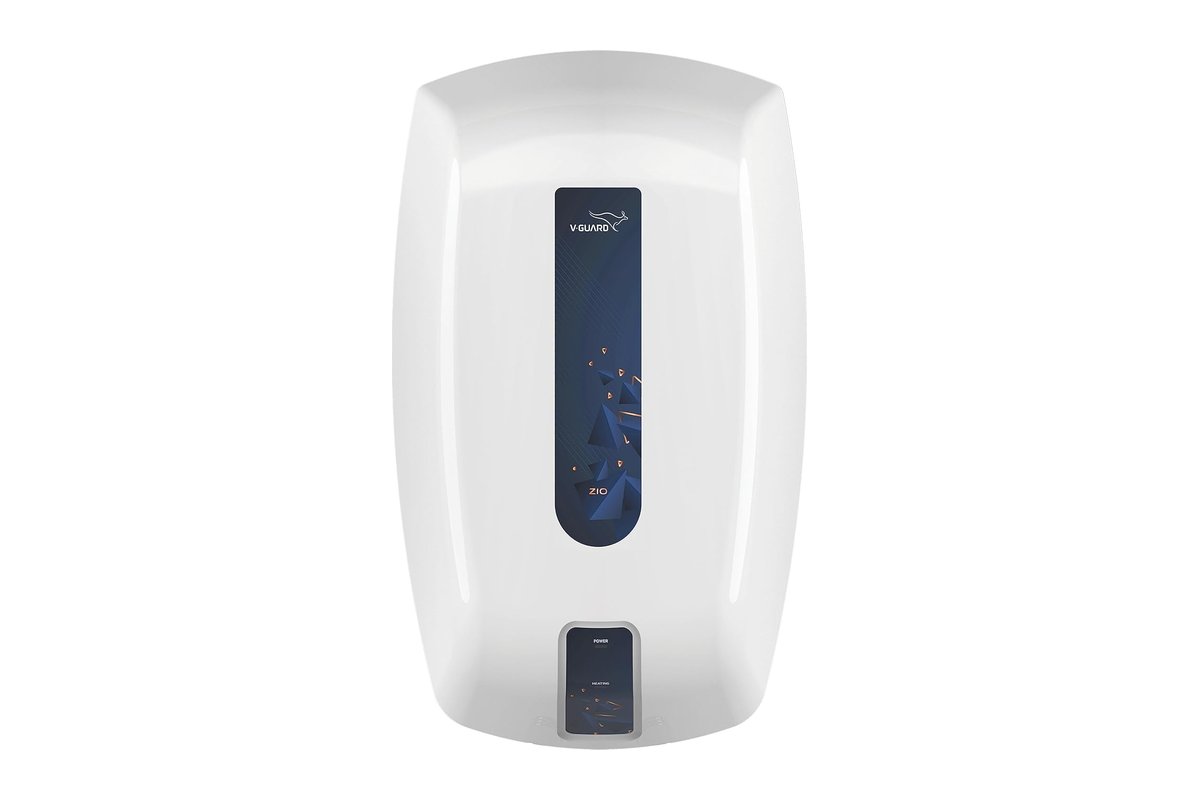
The simpler instant for a low-rise home on an overhead tank. Its tank is stainless steel, and it has the better owner ratings of the two, at 9% one-star. It is rated only 6 bar, so skip it on a pressure pump. It sells for about Rs 2,900.
V-Guard Zio 3L on Amazon India
V-Guard Divino (15 L and 25 L storage)
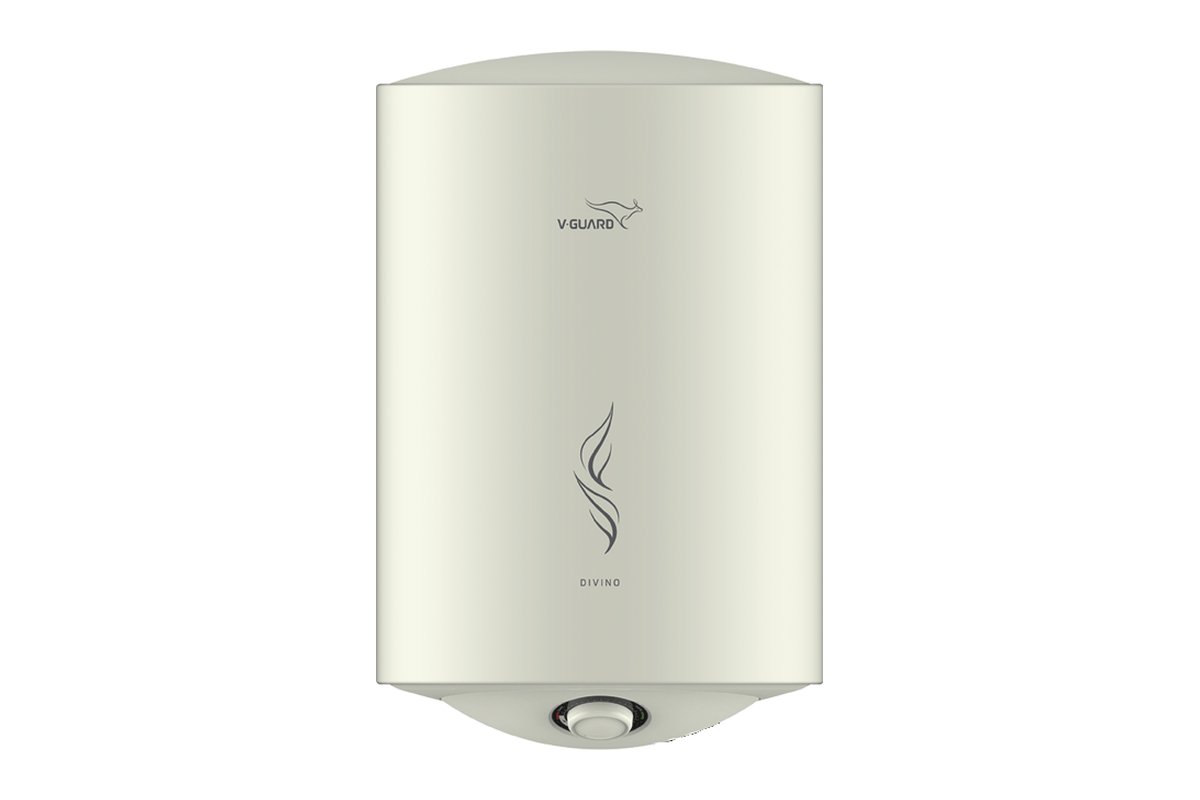
Our default for a family bathroom: an enamel-coated tank, a thick magnesium anode, a corrosion-resistant Incoloy 800 element and an 8 bar rating. It beats the cheaper Bajaj on owner experience, with 6% one-star ratings against 14%. It is 4 star on the current table, at 0.381 units a day for 15 litres. Around Rs 7,000 for 15 litres and Rs 7,900 for 25.
V-Guard Divino 15 on Amazon India · V-Guard Divino 25 on Amazon India
Bajaj Shield Series New Shakti (15 L and 25 L storage)
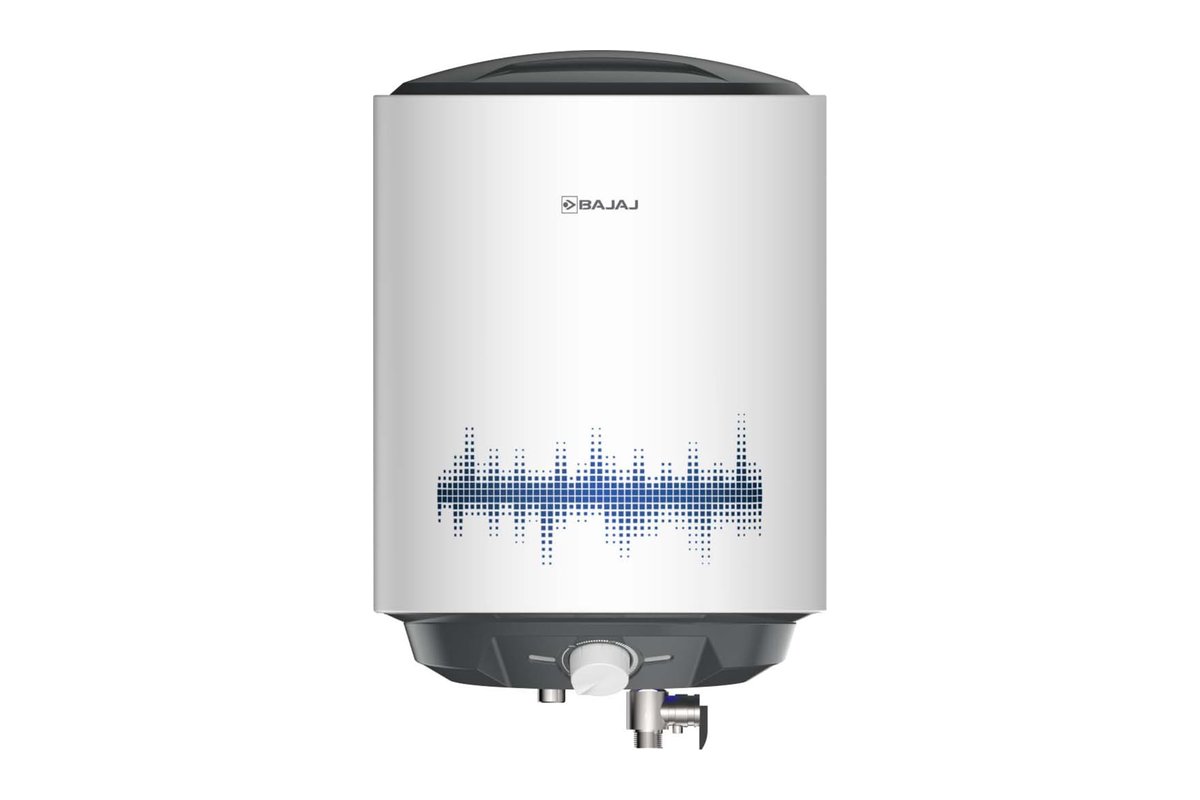
The lowest standing loss of our examples: 5 star on BEE’s current table at 0.346 units a day for 15 litres and 0.423 for 25. Bajaj covers the tank for seven years and the element for six. Owners are less happy than with the V-Guard. Prices run about Rs 6,500 for 15 litres and Rs 7,750 for 25.
Bajaj New Shakti 15L on Amazon India · Bajaj New Shakti 25L on Amazon India
A. O. Smith SDS-Green (15 L and 25 L storage)
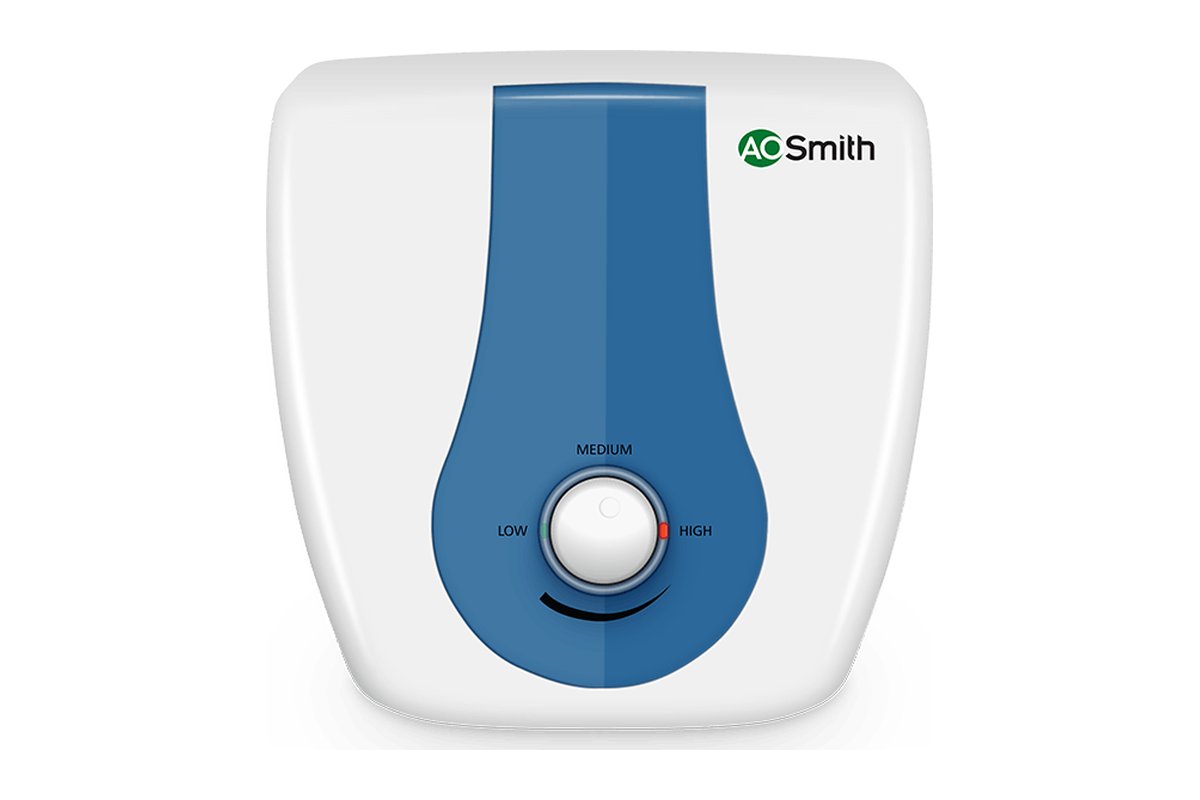
The storage geyser for hard water, with a glass-lined tank, a glass-coated element and a long-life anode. Amazon sells it as 5 star, but A. O. Smith’s own manual gives 0.410 units a day for 15 litres, which is 3 star today; read the label on the box. Budget about Rs 9,800 for 15 litres and Rs 10,800 for 25.
A. O. Smith SDS-Green 15 on Amazon India · A. O. Smith SDS-Green 25 on Amazon India
Where to go next
- Ready to buy? Our geysers for home guide ranks instant, 15 litre and 25 litre picks, with each star label checked against BEE.
- Comparing labels across appliances? The BEE star rating explainer covers what changed in 2026.
- Cold bathroom as well as cold water? See our room heaters for Indian winters.
Last updated: November 2026