For a 55-inch 4K TV, sit about 1.7 to 2.3 metres (170 to 230 cm, or 5.5 to 7.5 feet) away: the near end for films, the far end for everyday viewing. For any 4K TV the rule is simple: sit between 1.2 and 1.6 times the screen’s diagonal, so 55 × 1.2 is 66 inches, about 1.7 m. A Full HD TV needs you at the far end of that range or further back, and a 32-inch HD Ready set needs about 1.8 m before its pixels blend in.
Turn it around and the answer is bigger than most people guess: if your sofa puts your eyes 2.5 m from the screen, the size that fits is a 65-inch.
TV viewing distance by screen size
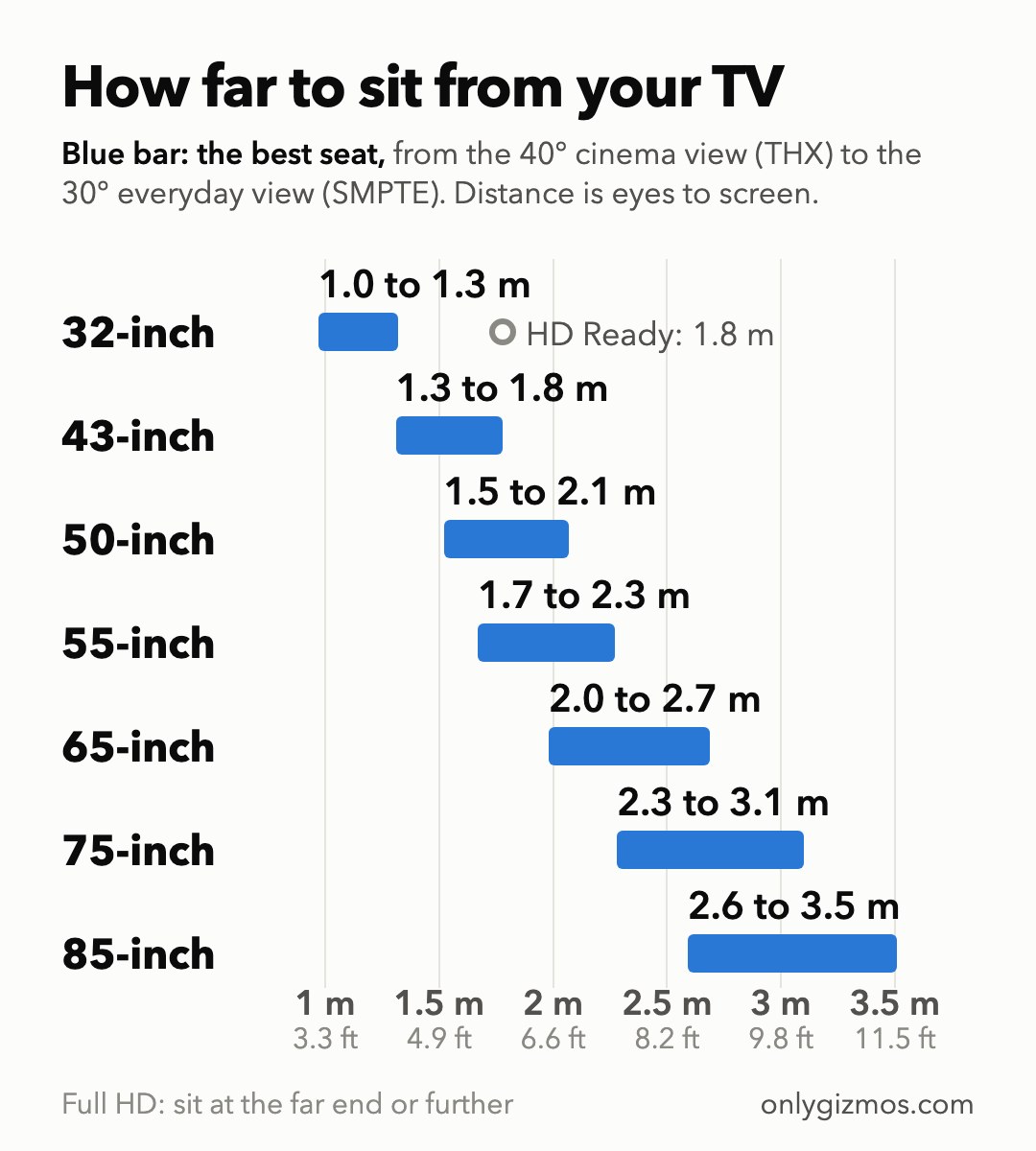
Measure from your eyes, in your usual seat, to the screen. Then find your size:
| TV size | Best distance (4K) | Full HD: no closer than |
|---|---|---|
| 32-inch | 1.0 to 1.3 m | 1.3 m (HD Ready: 1.8 m) |
| 43-inch | 1.3 to 1.8 m | 1.7 m |
| 50-inch | 1.5 to 2.1 m | 2.0 m |
| 55-inch | 1.7 to 2.3 m | 2.2 m |
| 65-inch | 2.0 to 2.7 m | 2.6 m |
| 75-inch | 2.3 to 3.1 m | 3.0 m |
| 85-inch | 2.6 to 3.5 m | 3.4 m |
Why these numbers work
How much of your view the screen fills. A screen that fills 30 degrees of your horizontal view, the guideline usually credited to SMPTE, suits everyday watching: news, cricket, serials. THX recommends 40 degrees for films, which feels closer to a good theatre seat. Samsung India’s own rule, 1.2 times the screen’s diagonal, is the 40-degree figure in disguise. For gaming, the 30-degree seat keeps a fast game’s whole screen in view, while the 40-degree seat suits story-driven games.
The maths is plain geometry. A 16:9 screen is about 0.87 times its diagonal wide, so a 30-degree view puts you 1.63 times the diagonal away and a 40-degree view 1.2 times. For a 55-inch screen that works out to 2.27 m and 1.67 m.
Further back, at 20 degrees, fine detail and on-screen text get uncomfortably small.
Whether you can see the pixels. Someone with normal 6/6 vision can pick out detail about one-sixtieth of a degree apart. Sit closer than the distance where each row of pixels shrinks to that size and you start seeing the grid instead of the picture. Sit further back and some of the panel’s detail is wasted on you.
For Full HD that limit is about 1.56 times the diagonal. For 4K it is 0.78 times, and for the 1366 × 768 HD Ready panel in current 32-inch HD TVs it is 2.2 times.
Put the two ideas together and you get the real reason to buy 4K. At the 30-degree everyday distance, normal eyes can only just resolve Full HD, so Full HD looks fine from there. Move up to the 40-degree cinema seat and Full HD starts to look coarse, while 4K still looks smooth. 4K is what lets you sit closer. On a 43-inch, that matters if you sit within about 1.7 m, where a Full HD panel starts to show its pixels. Sit far back and 4K’s case rests on HDR and its other picture upgrades, not pixels.
Which TV size to buy for your room
Read across:
| Eye-to-screen distance | Smallest size (30°) | Cinema size (40°) |
|---|---|---|
| 1.5 m (5 ft) | 40 or 43-inch | 50-inch |
| 2 m (6.5 ft) | 50-inch | 65-inch |
| 2.5 m (8 ft) | 65-inch | 75 to 85-inch |
| 3 m (10 ft) | 75-inch | 98-inch |
| 3.5 m (11.5 ft) | 85-inch | 100-inch and up |
These assume a 4K TV, the norm at 50 inches and up. One metre is about 3.3 feet. The “smallest size” column is a floor, not the ideal.
Room length is not viewing distance. Buyers often ask “what size for a 12×12 room?”. Subtract first. In a 12-foot (3.7 m) room, if the TV unit and wall gap take about 0.45 m and the sofa back to your eyes takes about 0.7 m, you are left with roughly 2.5 m. That is 65-inch territory. A “10-foot room” works out the same way: about 1.9 m eye to screen, so a 50 or 55-inch fits.
Try the size before you buy. Tape a few sheets of newspaper together, or use masking tape, to mark the screen’s outline on the wall, then sit in your usual seat. A 55-inch screen is about 1.22 m wide and 0.68 m tall; a 65-inch is about 1.44 m by 0.81 m.
When the budget says 55 and the room says 65. Say your eyes are 3 m from the screen and your budget stops at 55 inches. At 3 m a 55-inch fills about 23 degrees of your view, well short of the 30-degree minimum. News and serials stay perfectly watchable; subtitles, sports graphics and films are where you notice it.
Our advice: try the free fix first. Move the sofa, or put a pair of chairs, about 2.3 m from the screen. That one change gives a 55-inch the same 30-degree view a 65-inch gives at 2.7 m. If the furniture can’t move, a 65-inch at 3 m fills 27 degrees, which is close enough, and a 75-inch hits 31.
Bedrooms. From a bed 1.5 m away, a 43-inch fills about 35 degrees, which is ideal, and a 50-inch is the cinema option. If a 43-inch would swamp the room, a 32-inch at 1.5 m still fills about 27 degrees: a little small, but fine for news and serials. On a tight budget, our best smart TVs under Rs 20000 cover both sizes.
Full HD or HD Ready at 32 inches. Here resolution matters more than size. A Full HD 32-inch looks clean from 1.3 m, the right bedroom distance. An HD Ready panel needs you back at 1.8 m before the pixel grid disappears, and at that distance the screen fills only about 22 degrees. If you sit close, pay for Full HD.
Many DTH channels are still SD. Tata Play’s SD box sends 576 lines; its HD box sends 1080. On a 4K panel each SD line has to be stretched across almost four rows of pixels. A 6/6 eye only stops noticing SD’s softness at about 2.9 times the diagonal, roughly 4.1 m for a 55-inch, further back than most living rooms allow. If your family mostly watches SD channels, upgrade to HD channels before you upgrade the screen size, or the bigger TV will make the softness more obvious.
43 vs 55-inch TV: which size for your room?
Screen area grows with the square of the diagonal, so each step up is bigger than it sounds. A 55-inch has 64% more picture than a 43-inch, not 28% more, and is 27 cm wider. The test is simple: once you sit beyond the smaller TV’s 30-degree distance, it falls below the everyday minimum, so go bigger.
| Comparison | The bigger screen | Pick it from |
|---|---|---|
| 32 vs 43-inch | +81% area, 24 cm wider | 1.3 m |
| 40 vs 43-inch | +16% area, 7 cm wider | 1.7 m |
| 43 vs 50-inch | +35% area, 15 cm wider | 1.8 m |
| 43 vs 55-inch | +64% area, 27 cm wider | 1.8 m |
| 55 vs 65-inch | +40% area, 22 cm wider | 2.3 m |
| 55 vs 75-inch | +86% area, 44 cm wider | 2.3 m |
For 43 vs 55 inches: up to about 1.7 m, buy the 43 (our best 43-inch smart TVs), because a 55 that close fills more than the 40-degree cinema view. From about 1.8 m, the 55 is the right size: our best 55-inch 4K TVs under Rs 60000 are the place to start. In between, let the budget decide. 40 vs 43 inches is a small gap: past 1.7 m take the 43, otherwise choose on price and resolution.
Height and viewing angle
Put the middle of the screen near your seated eye level. A good starting point is the screen’s centre about 107 cm (42 inches) above the floor, roughly where a 5 ft 6 in adult’s eyes sit on a standard sofa. Your sofa or diwan may sit lower than that, so sit in your usual spot and have someone measure your eye height. If a TV unit is in the way, mount the TV 10 to 15 cm above the unit’s top rather than higher.
THX’s limit is that you should not tilt your eyes up more than 15 degrees. At 2.5 m, 15 degrees is about 67 cm above eye level, so if the middle of the screen sits higher than that, it is too high.
For a bedroom where you watch lying down, the TV can go higher, but use a tilting mount and angle it down, keeping the tilt to 15 degrees or less.
Sitting off to the side
Family viewing rarely happens from one chair. Someone 1 m to the side of the screen’s centre at 2.5 m is about 22 degrees off-axis; at 2 m, the same seat is 27 degrees off.
That matters because of the panel. IPS panels hold their colour and contrast much better from the side. VA panels have deeper blacks head-on, but the picture loses accuracy quickly as you move off-centre: colours wash out and dark scenes turn grey. OLED holds up better than both.
If your seating is a wide L-shaped sofa plus a diwan, we’d give viewing angle real weight when you shortlist. If everyone sits straight in front, VA’s contrast is the better deal.
Bright rooms
Distance won’t fix glare; position will. Every TV reflects some light, so in a room with big windows choose a TV with good reflection handling and high brightness. A screen directly opposite a window or glass balcony door will show reflections whatever you buy. A side wall, or a few degrees of angle, helps more than you would expect, and sheer curtains handle the rest. Use a brighter picture mode in the day and Cinema or Film at night.
Myths and marketing terms
“Sitting close will ruin your eyes.” It won’t. The American Academy of Ophthalmology says screens do not permanently damage your eyes. Long sessions can cause eye strain, which looking away at something in the distance eases.
“Multiply the screen size by 1.5” (or 1.2, or 2.5). Brand blogs quote different multipliers, but each one works out to a viewing angle. 1.2 times is the 40-degree cinema view, 1.5 about 32 degrees, 1.6 the 30-degree everyday view, and 2.5 about 20 degrees, which is too far for most people. Pick the angle, not the rule.
“Ultra Viewing Angle” and “X-Wide Angle.” Samsung’s and Sony’s names for viewing-angle technology on some higher-end VA TVs. They widen the angle a bit, at some cost to contrast; they don’t make a VA panel match IPS from the side.
“8K for a sharper picture.” On a 65-inch screen, 8K only starts to look sharper than 4K from closer than about 1.3 m, and you would need to sit about 0.6 m away to see all of it. There is also very little 8K content to watch. We wouldn’t pay extra for it.
Where to go next
- Best 43-inch smart TVs: 4K, QLED and Mini LED picks for 1.3 to 1.8 m.
- Best 55-inch 4K TVs under Rs 60000: for 1.7 to 2.3 m.
- Best smart TVs under Rs 20000: 32 and 43-inch picks on a budget.
Last updated: October 2026