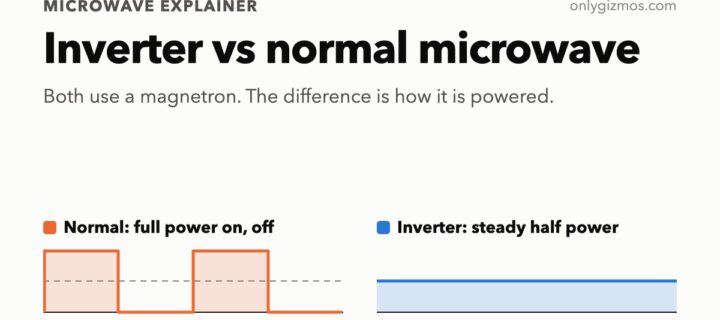
It isn’t magnetron versus inverter. Almost every microwave, inverter models included, uses a magnetron to make the microwaves; “inverter” describes the power supply that feeds it. An inverter board drives the magnetron at a steady, reduced power, while a normal microwave’s transformer can only run it at full power, so it pulses on and off to fake the lower settings.
That difference is real, but smaller than the label suggests. Independent tests find inverters help with melting and gentle low-power cooking, not with everyday reheating. And in India you can barely buy one: Panasonic, the brand that made inverter microwaves famous, sells none here. So don’t chase the word. Buy on type, size and the magnetron warranty, and know what “inverter” means when a listing uses it.
What the magnetron does
The magnetron is the electron tube that turns electricity into microwaves. They bounce around the metal cavity and make the water in food vibrate, and that friction is the heat. Every microwave you can buy in India has one: solo, grill or convection, cheap or expensive.
A magnetron runs on a very high voltage, far above the 230 V from your socket, so something has to step the supply up. That something is the core difference between the two types.
- A normal microwave uses a heavy mains transformer with a high-voltage capacitor and diode.
- An inverter microwave replaces those parts with an electronic circuit board that switches power at high frequency. It still has a magnetron, and still needs one replaced when it fails.
One YouTube teardown of two similar Sharp ovens shows it plainly. Both have a magnetron and a cooling fan. Where the regular oven has a big transformer and capacitor, the inverter has a circuit board, and it is much lighter despite being slightly bigger. (Don’t try this: the capacitor can hold a dangerous charge.)
How a normal microwave fakes 50% power
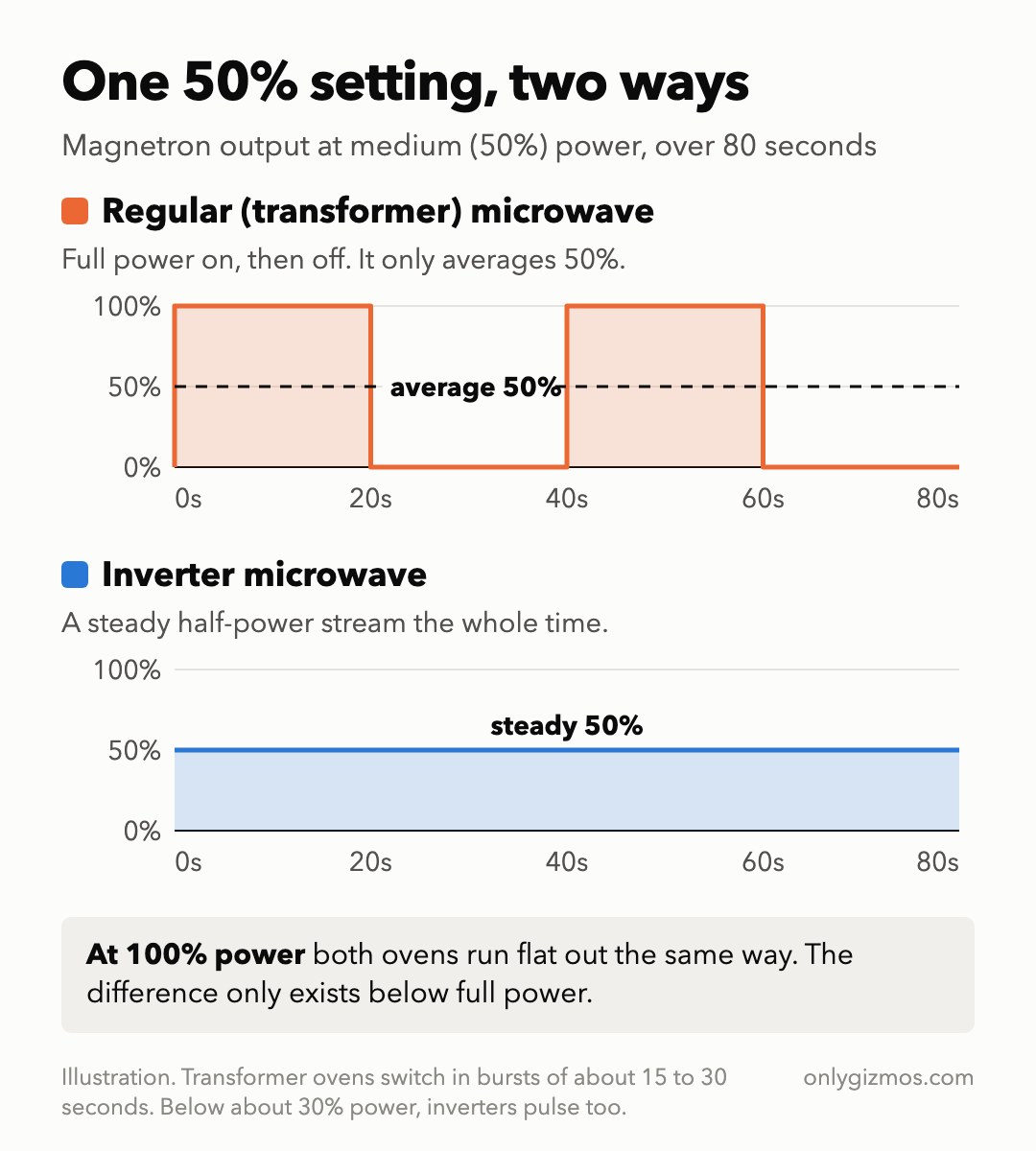
A magnetron fed by a simple transformer is either on at full power or off. So when you press “medium”, the oven times it: full power for a stretch, then nothing, then full power again. Over each on-off cycle it averages out to 50%.
Those stretches are long. At 50%, a conventional oven typically runs flat out for 15 to 30 seconds and then switches off for about as long.
For a large dish that hardly matters, because heat keeps spreading through the food during the off stretch. For a small, fragile job, like melting chocolate or butter or softening a frozen block of keema, those long bursts at full power are where edges overcook while the middle stays frozen.
What the inverter changes
An inverter oven set to 50% sends out half power continuously. Instead of on, off, on, it is one steady stream, which is gentler on food that scorches easily.
Two limits matter before you pay for it:
- At full power, there is no difference. Reheating a plate of food usually happens at 100%, where both types simply run the magnetron flat out.
- At the lowest settings, inverters pulse too. A magnetron needs a minimum power to run, so below about 30% inverter ovens switch on and off like a normal oven. Many inverter auto-defrost programmes also rely on pulsing.
What it means in your kitchen
Defrosting. This is the headline promise, and independent tests say it barely matters. Australia’s CHOICE tested both types and saw no real gap in how evenly they heated, reheated or thawed food, or in how long they took. America’s Test Kitchen found no measurable benefit from the inverter on a Panasonic model and got better results from its sensor programmes. One YouTube side-by-side found an inverter thawed a pound of beef in about half the time (8 minutes against 16), but that inverter was also a 1200 W oven against a 1000 W one. Good defrosting depends more on the programme, the wattage and turning the food.
Delicate food. Here inverters have a genuine edge. In CHOICE’s chocolate test, every inverter melted it smoothly, while the one regular oven with a melt programme left it unusable. If you often melt butter or chocolate, soften ghee, warm milk or cook eggs and custards in the microwave, an inverter is easier to get right. On a normal oven, short bursts and stirring get you close.
Electricity. Brands claim savings: Godrej says its inverter uses 11% less power than a regular oven, and IFB says “up to 30%”. CHOICE’s running-cost measurements found the two types overlap, with no clear winner. Even on the brands’ figures, the money is small.
Size and weight. The board is lighter than a transformer, so an inverter oven weighs less and can fit a bigger cavity in the same box.
The buyer maths
Take a typical 900 W oven like the IFB 24PM2S, which draws 1400 W while it runs. Use it at full power for 15 minutes a day and that is 0.35 units a day, or about 128 units a year. At Rs 8 a unit, it costs roughly Rs 1,020 a year to run.
| Claimed saving | Saved a year | Years to recover Rs 10,000 |
|---|---|---|
| 11% (Godrej’s figure) | about Rs 110 | about 90 |
| 30% (IFB’s best case) | about Rs 310 | about 33 |
Rs 10,000 is roughly the extra an inverter costs in India today (see below). Even at 30 minutes a day and IFB’s best case, payback takes about 16 years. An inverter can be worth buying for how it cooks. It won’t pay for itself.
Can you buy an inverter microwave in India?
Barely. This is where foreign “inverter vs normal” articles don’t help Indian buyers.
- Panasonic launched its first inverter microwave in 1988 and sells inverter models in many countries. Its Indian store lists ovens from 20 L solos to 29 L convection models, and none is sold as an inverter. Indian sites recommending “a Panasonic inverter” describe models sold abroad.
- Godrej has the one inverter model you can readily order: the GME 728 CIP3 RM, a 28 L convection oven with 1000 W of microwave power and five years on the magnetron. It isn’t on Amazon and Godrej doesn’t list a price; retailers sell it for roughly Rs 10,000 more than a similar regular oven such as Panasonic’s 27 L NN-CT645BFDG (around Rs 13,000).
- IFB makes the 34FBBSC2, a 34 L steam oven with an inverter, at about Rs 52,000 on IFB’s store. It is out of stock, and none of IFB’s mainstream ovens is an inverter.
- LG sold a 42 L “Smart Inverter” solo, the MS4295DIS. It is no longer in LG India’s range, and the current LG ovens we checked don’t mention an inverter.
- Samsung, Whirlpool and Morphy Richards list no inverter microwaves in India.
On Amazon India, the first page of results for “inverter microwave oven” is all regular solo, grill and convection ovens, plus a few OTGs. If you want an inverter, you are choosing from one or two models at a big premium.
When inverter on a listing means something else
Inverter ACs and fridges have made “inverter” a selling word in India. There it means the compressor changes speed, the feature behind our best 1.5 ton 5 star inverter ACs. In a microwave it only changes how the magnetron is powered, so read the word on a microwave listing with suspicion.
- An unexplained claim. Haier’s 19 L solo, the HIL1901MBPB, is titled “Solo Microwave Oven with Inverter Technology”, yet nothing on Haier’s page says what that inverter does. It also costs less than Haier’s own regular 20 L solo. It may be genuine, but until Haier explains it, treat the word as unproven.
- Power backup, not technology. “Inverter” in India also means the battery backup in your home, and appliance listings mix the two. The clearest case we’ve seen is a fridge: a Whirlpool double-door lists “Auto Connect to Home Inverter”, meaning it can run on backup power, while its compressor is fixed speed. Its Amazon title still calls it an inverter fridge. Expect the same confusion on microwaves.
- A type filter. Retailer filters and spec rows can show “Type: Inverter” next to solo, grill and convection. Inverter isn’t a type of microwave. It is a power supply that can sit inside any type.
The rule: trust the word only when the brand explains continuous or variable microwave power.
Can you run a microwave on a home inverter?
Not on a common 900 VA home inverter, which can supply only about 750 W. A microwave draws far more than its output rating: a 900 W oven like the IFB 24PM2S draws 1400 W. Before you plug one into backup power, check the input wattage on the oven’s rating plate against your inverter’s watt rating, and leave headroom.
Why the magnetron warranty matters more
Whichever type you buy, the magnetron is the part that makes a microwave work, and its warranty is what owners ask about most. In an inverter oven, the other high-voltage parts sit on one board, which is usually replaced as a whole rather than repaired.
Magnetron cover in India ranges from nothing beyond the first year to a decade. IFB gives three years on the magnetron and cavity, Haier four on its air-fry convection model, Godrej five on its inverter, and Midea ten on its budget solo, while LG and Panasonic budget solos get one year in total. No brand spells out separate cover for the inverter board, and Godrej’s own page gives five years of comprehensive cover in one place and one year in another. Get the board’s cover in writing before you pay, and keep the invoice.
That gap is worth more than the inverter badge. A regular oven with three to five years on the magnetron is a safer buy than an inverter with one. Our guide to microwaves with air fryer and convection compares warranty terms model by model.
So should you pay for an inverter?
- You mostly reheat, cook rice and make Maggi at full power. No. Buy a regular solo or grill oven from a brand with a long magnetron warranty. Our pick is the IFB 24PM2S, a 24 L solo at around Rs 8,800 with three years on the magnetron and cavity.
- You bake, grill and want one oven for everything. No. Choose convection on size, temperature range and warranty; our best microwaves with air fryer and convection names the ones worth buying. The inverter changes only how microwave power is delivered, not the convection heater or grill.
- You often melt chocolate or butter, or cook delicate food, and the price gap doesn’t bother you. Yes, an inverter will make those jobs easier, but the choice in India is a model or two. Check stock and warranty first.
Where to go next
- If you want an oven that bakes and air-fries, start with our best microwaves with air fryer and convection.
- If you only need to reheat and defrost, a solo oven with a long magnetron warranty is the sensible buy. Choose 20 L for one or two people and 23 to 25 L for a family.
Last updated: October 2026