Yes, air purifiers work, for one job: pulling fine particles (PM2.5) out of a closed room that the purifier is big enough for. Across 83 field studies, portable purifiers cut indoor PM2.5 by about half on average. They do far less with the window open, in a room twice their size, or against gases and smells.
So the real question is whether the one you buy is big enough for your room, and whether you’ll run it properly. If you only want our picks, go to our guide to the best air purifiers for home in India.
Do air purifiers really work? What Delhi and Shanghai trials found
The best evidence comes from cities that look like Delhi in November.
- Shanghai dormitories: in a blinded trial, 48 hours of real filtration averaged 41 µg/m³ against 96 with a dummy filter, a 57% cut. Blood pressure and inflammation markers dropped too.
- Shanghai bedrooms: children’s bedrooms with HEPA purifiers averaged 10 µg/m³ against 34 without. Their total exposure only fell from 40 to 25, because they spent much of the day elsewhere.
- Ulaanbaatar homes: indoor PM2.5 was 29% lower with purifiers. The gap was 40% at first and only 15% after about five months, a reminder that filters and habits need upkeep.
- Delhi: in a winter test in one 150 sq ft room, even cheap HEPA set-ups cut fine-particle counts substantially. But with outdoor PM2.5 averaging 260 µg/m³, the room often stayed dirtier than outdoor air in a moderately polluted city, and the gain shrank on the worst days.
One Delhi study should worry every owner. Monitors inside Delhi homes found winter PM2.5 at over 20 times WHO’s guideline level, higher than at the nearest outdoor monitor. Richer homes were 13 times as likely to own a purifier, yet their air was only about 10% cleaner. Owning one isn’t the same as cleaning a room with one.
On health, be realistic. Short trials show modest gains, such as systolic blood pressure about 4 mmHg lower across ten trials. None has shown fewer heart attacks or deaths. Still, cleaner air in the room where you sleep is the most direct protection you can buy for a smog week.
How do air purifiers work? HEPA in plain words
A purifier is a fan that pulls room air through a dense mat of fine fibres and blows it back out. Large particles crash into the fibres; the tiniest ones drift around until they stick. The hardest size to catch sits in between, around 0.3 micron.
That’s why the HEPA standard is set at that size. A true HEPA filter catches at least 99.97% of 0.3-micron particles and does even better on bigger and smaller ones. Indian boxes also use European grades: H13 means at least 99.95% at that hardest size, and H14 at least 99.995%. Either is plenty for a home.
“HEPA-type” and “HEPA-like” mean nothing. No standard sits behind those words. In one US trial, a low-efficiency “HEPA-type” filter cut people’s PM2.5 exposure by about 30%, against about 52% for true HEPA. Look for “H13”, “True HEPA” or an efficiency figure at a stated particle size.
But a 99.97% filter that only moves a trickle of air cleans the room slowly. Airflow is what CADR measures.
What size air purifier do you need? A room calculator
CADR (clean air delivery rate) is how much particle-free air a purifier delivers at top speed. It combines filter efficiency and fan power, so it’s the one number to compare. American ratings use cubic feet per minute (cfm); Chinese and most Indian boxes use cubic metres per hour (m³/h). One cfm is 1.7 m³/h.
AHAM, the US appliance body, sizes rooms for 4.8 air changes an hour, meaning the purifier cleans the room’s whole volume of air 4.8 times. Its shortcut: CADR in cfm should be at least two-thirds of the floor area in sq ft. That assumes an 8 ft ceiling. Indian flats often have ceilings of 9 or 10 ft (2.75 m is the building-code minimum for habitable rooms), and more height means more air to clean.
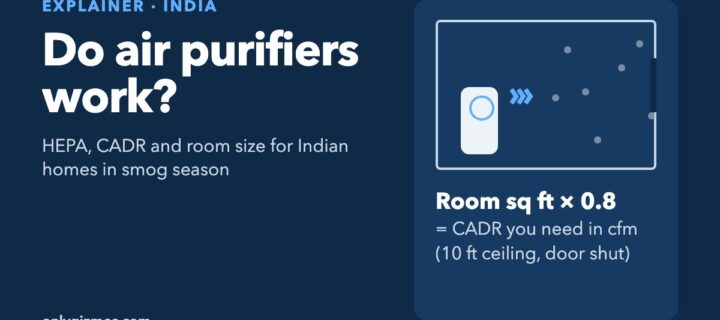
For a 10 ft ceiling, multiply your floor area in sq ft by 0.8 for the CADR you need in cfm, or by 1.36 for m³/h. With a 9 ft ceiling you need 10% less; at 8 ft, use AHAM’s two-thirds.
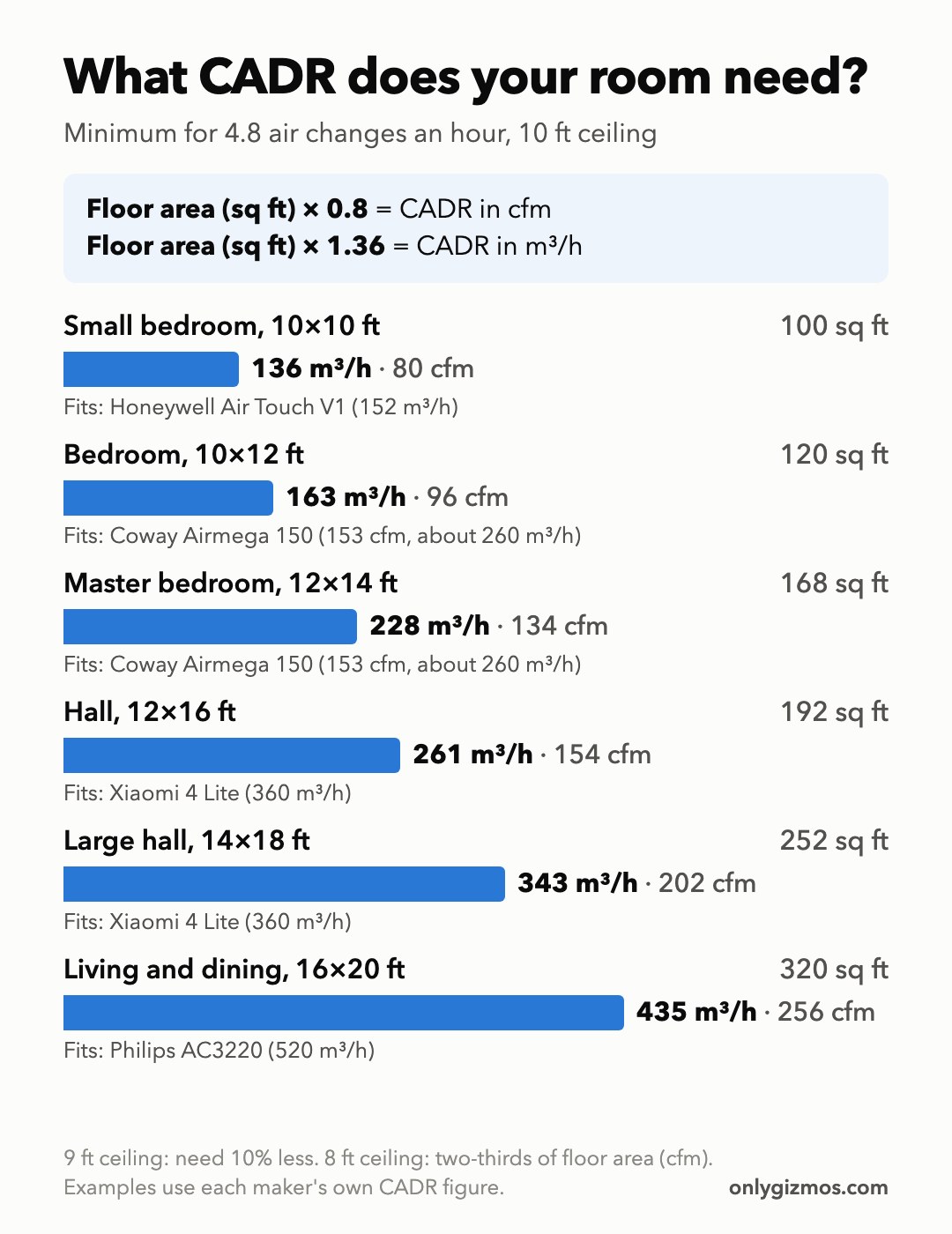
| Room (10 ft ceiling) | CADR you need | Smallest example that fits |
|---|---|---|
| 10×10 ft bedroom | 136 m³/h (80 cfm) | Honeywell Air Touch V1 |
| 10×12 ft bedroom | 163 m³/h (96 cfm) | Coway Airmega 150 |
| 12×14 ft master bedroom | 228 m³/h (134 cfm) | Coway Airmega 150 |
| 12×16 ft hall | 261 m³/h (154 cfm) | Xiaomi 4 Lite |
| 14×18 ft hall | 343 m³/h (202 cfm) | Xiaomi 4 Lite |
| 16×20 ft living and dining | 435 m³/h (256 cfm) | Philips AC3220 |
From each maker’s own CADR, this is the room each one really suits at 10 ft:
- Honeywell Air Touch V1 (152 m³/h, around Rs 5,000): about 110 sq ft. The box says 235. The Eureka Forbes 150 is the same size and price.
- Coway Airmega 150 (153 cfm, about 260 m³/h, around Rs 15,000): about 190 sq ft, just short of a 12×16 hall.
- Xiaomi Smart Air Purifier 4 Lite (360 m³/h, around Rs 11,000): about 265 sq ft.
- Philips AC2220 (420 m³/h, around Rs 20,000): about 310 sq ft.
- Philips AC3220 (520 m³/h, around Rs 19,850): about 380 sq ft.
Our air purifier guide quotes coverage for an 8 ft ceiling, so its figures read about a quarter larger. India has no mandatory test or star label for purifiers, so every CADR here is the brand’s own, measured to different standards (Coway’s to the US method, Xiaomi’s to China’s). Treat a 10% gap as a tie, and ignore the room size printed on the box: do the sum instead.
Between sizes, go bigger. A larger purifier can run on a slower, quieter speed and still keep up, and noise is a big reason people turn purifiers down or off.
Do air purifiers work with windows open?
Not well. A purifier’s rated room size assumes almost no outside air coming in. Open a window and smog keeps flowing in faster than the purifier can clean it. In field studies during smoke events, opening the windows roughly halved the benefit.
- Close the door. With the door open, a bedroom purifier is trying to clean the whole flat.
- Seal the obvious gaps, such as the space around a window AC or a broken pane. Tape is a cheap fix.
- Ventilate in short bursts when you need fresh air, then close up and let the purifier catch up.
- Don’t count on your split AC. Its mesh filter keeps lint and hair out of the coil and doesn’t catch fine particles. Run the purifier in the AC room with the door shut; the two work fine together.
Keep the purifier clear of walls, curtains and furniture so air can reach it.
Do air purifiers work for smoke and dust?
- Smoke and Diwali haze: yes. Smoke is the fine PM2.5 that HEPA catches, and smoke CADR is the headline rating.
- Dust: yes for the fine dust in the air. What settles on the floor still needs a mop.
- Allergies: partly. Pollen-sized particles are heavy and settle quickly, and most home purifiers don’t move enough air to catch them first.
- Smell, gases and VOCs: barely. Removing gases takes a lot of activated carbon: effective units hold half a kilo to five kilos of it. The thin carbon sheet in a typical home purifier takes the edge off cooking or firecracker smell for a while, then saturates. CADR says nothing about gases.
Is an air purifier worth it? What it costs to run
With no BEE star label to go on, work out the bill from the rated watts. Electricity turns out to be cheap; the filter is the real running cost. This is the worst case, at top speed for 12 hours a day all year, at Rs 8 a unit.
| Purifier (power) | Electricity a year | Filter a year |
|---|---|---|
| Honeywell Air Touch V1 (12 W) | 53 units, about Rs 420 | about Rs 2,100 |
| Philips AC2220 (28 W) | 123 units, about Rs 980 | rated 3 years; refill not yet sold |
| Xiaomi 4 Lite (33 W) | 145 units, about Rs 1,160 | Rs 3,000 to Rs 6,000 |
| Philips AC3220 (36 W) | 158 units, about Rs 1,260 | about Rs 5,100 |
| Coway Airmega 150 (38 W) | 166 units, about Rs 1,330 | about Rs 2,400 |
Together that’s about Rs 2,500 a year for the Honeywell, Rs 3,750 for the Coway, Rs 4,150 to Rs 7,150 for the Xiaomi and Rs 6,350 for the Philips AC3220. Most homes spend less: auto and sleep modes draw a fraction of top-speed power, and many families only run a purifier from October to February.
A clogged filter makes any purifier useless, so check the refill is sold before you buy: the Xiaomi’s genuine filter is only on Xiaomi’s own store, and the Philips AC2220’s isn’t on sale in India yet. Its three-year rating buys time, but it’s a risk on a new model.
So is it worth it? If your city has a smog season and your home has children, older parents or anyone with asthma, we think it’s an easy yes. If your AQI stays Good or Satisfactory most of the year, it’s a nice-to-have.
Ionisers and ozone: what to avoid
Some purifiers add an ioniser, “plasma” or UV mode. These electronic modes can give off ozone, a lung irritant that can worsen asthma. Even California-certified ionisers, capped at 0.05 ppm of ozone, can give off small amounts, so use them cautiously. Devices sold as “ozone generators” are worse: at levels safe to breathe, they don’t clean the air.
In India the feature hides in look-alike models. The full Xiaomi Smart Air Purifier 4 has negative ions on by default (the 4 Lite has none), the Honeywell Air Touch V4 adds an ioniser and UV, and Sharp sells Plasmacluster models. A good HEPA filter needs none of it, so buy one without an ioniser or switch it off.
Why the AQI on your purifier can mislead you
That coloured light comes from a cheap laser sensor, and cheap sensors are rough. In US government tests, raw readings from a popular low-cost monitor ran about 40% high, and higher still in humid air, which is exactly what Delhi’s foggy winter mornings bring. Owners of several purifiers report lights that read wrong or stay red.
The scale is a second trap, so check whether your purifier or its app uses the US AQI or India’s. At the levels a purified room often sits at in smog season, the US scale gives a scarier number: 60 µg/m³ is “Satisfactory” (AQI 100) on India’s scale but “Unhealthy” (AQI 154) on the US one. At outdoor smog levels it flips, and 150 µg/m³ is 323 on India’s scale against 225 on the US one.
Read the PM2.5 figure in µg/m³ if your purifier shows it, and treat the light as a trend. India’s 24-hour limit is 60 µg/m³; the WHO guideline is 15.
Air purifier vs humidifier: which do you need?
They solve different problems. A purifier removes particles; a humidifier adds moisture and does nothing for PM2.5.
In the north Indian smog season you rarely need a humidifier. Delhi’s evening humidity averages 52% to 59% from November to January, and foggy mornings reach 85% to 97%. Indoor humidity should stay under 50% to keep mould away. A humidifier earns its place only in a dry, heated room or a dry inland winter, when a hygrometer reads below about 30%.
If you use both, be careful with ultrasonic humidifiers. Filled with tap water, they spray its minerals into the air as fine dust; in one study a unit pushed room PM2.5 to anywhere from 16 to 350 µg/m³ depending on the water. That can fool a purifier’s sensor into running flat out. Use distilled water.
For a baby’s room, buy the purifier first and add a humidifier only if you measure dry air.
Can a DIY fan filter do the job?
Partly, and it’s an honest option if money is tight. In the Delhi room test, a table fan with a HEPA filter tied on (about 60 cfm) cut particle counts substantially. In US government tests, a box fan with a fine filter taped to the back delivered about 111 cfm, matching a small commercial purifier.
The catches: 60 cfm only suits a room of about 75 sq ft at a 10 ft ceiling. DIY fans are louder and use more power than a purifier with the same output. In heavy smog the filter can clog within weeks, and a loaded one does almost nothing. And use a newer fan with a thermal cut-off; never leave an old fan running unattended or overnight.
It’s a stop-gap for a smog week, not a better deal than a Rs 5,000 purifier you can run all night.
So should you buy one?
Yes, if your city has a smog season and you can keep one room closed. Start with the bedroom, where you spend the most hours, size it with the calculator above and keep the door shut.
- One small bedroom on a tight budget: the Honeywell Air Touch V1, for rooms up to about 110 sq ft.
- A typical 10×12 or 12×14 bedroom: the Coway Airmega 150, with the strongest owner record of the lot. It costs more up front than the Xiaomi 4 Lite, but its filter is on Amazon and cheaper per year.
- A hall up to about 300 sq ft: the Philips AC2220, or the Xiaomi 4 Lite to save about Rs 9,000 if the room is under about 265 sq ft.
- A living and dining room over 300 sq ft: the Philips AC3220, about 380 sq ft for the same money, with its filter on Amazon.
Our best air purifiers for home in India guide compares these picks in detail, with filter prices, noise and the models we left out.
Last updated: October 2026