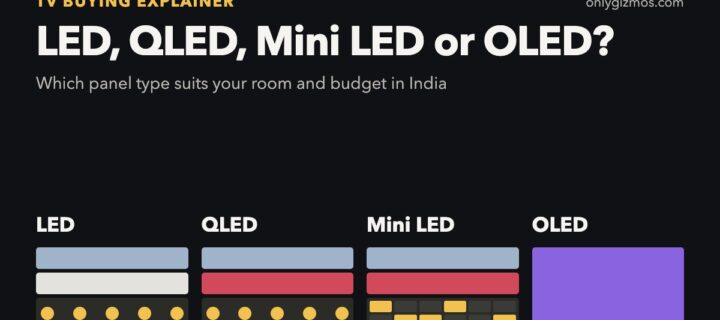
Under about Rs 40,000 for a 55-inch TV in India, buy a good LED or QLED set and don’t pay extra for the QLED badge alone. From about Rs 60,000, a Mini LED TV with real local dimming is the best all-rounder and the clear choice for a sunny living room. A 55-inch OLED costs about Rs 95,000 and up, and gives the best picture in a dim room, with one habit to avoid: the same logo on screen for hours every day.
Torn between Mini LED and OLED, or Mini LED and QLED? If you can stretch, we’d put the money into Mini LED: it suits the most Indian living rooms. Here’s why, and which labels to distrust.
LED vs QLED vs Mini LED vs OLED: the short answer
| Panel type | Buy it if | 55-inch price |
|---|---|---|
| LED | Your budget is tight | About Rs 34,000 |
| QLED | You want richer colour on a budget | About Rs 35,500 |
| Mini LED | You watch in daylight or want HDR punch | About Rs 60,000 |
| OLED | You watch films in the evening | About Rs 95,000 |
Two ways to make a picture
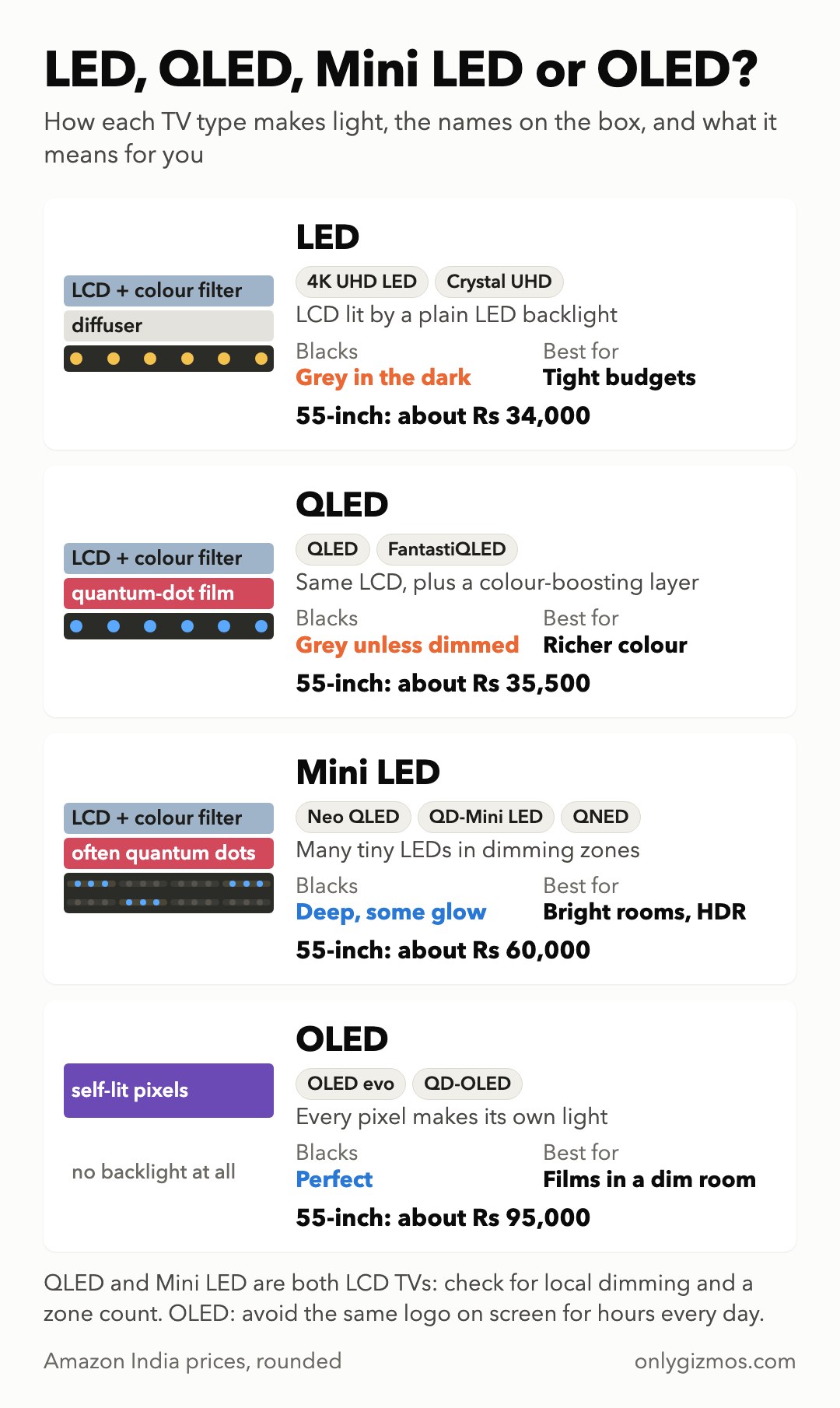
LED, QLED and Mini LED TVs are all LCD TVs. LEDs behind the screen or along its edges make the light, a liquid-crystal layer opens and closes like millions of tiny shutters, and a colour filter turns what gets through into red, green and blue. “LED” describes the backlight, not a different kind of screen.
In an OLED TV, every pixel makes its own light and can switch fully off. There’s no backlight.
Everything else follows from that: an LCD can only get as dark as its backlight allows, while an OLED is black wherever the picture is black.
LED TVs: the backlight decides the blacks
Edge-lit sets put the LEDs along the sides, pointing inward. They’re thin and cheap but can only dim large sections of the picture. Direct-lit sets put rows of LEDs behind the whole screen for more even light, though most budget ones still can’t dim one area on its own.
The feature that matters is local dimming: the backlight is split into zones that dim independently, so the sky behind the moon goes dark while the moon stays bright. Without it, the backlight dims as one block and night scenes come out grey.
Price doesn’t guarantee it. Sony’s premium-priced Bravia 3 II (K-55XR35M2) uses what Sony calls frame dimming: the whole backlight dims together, with no local zones.
VA or IPS: contrast or viewing angle
VA panels block light far better, so blacks look deeper. That’s why most LCD TVs use them, including TCL’s Q6C and C7L (HVA panels). From the side, though, their colour and contrast fade quickly.
IPS panels keep their colour off-angle, which suits a wide sofa or an L-shaped seating plan, but their contrast is low (often around 1,000:1), so blacks look grey in a dark room.
If the family sits straight in front of the TV, VA is the better trade; for viewing from the dining table at an angle, IPS or OLED. Ignore the “178° viewing angle” on spec sheets: it’s where contrast has fallen to about 10:1, barely watchable, and VA sets quote it too.
QLED: better colour, same backlight
A QLED is an LCD with a film of quantum dots: tiny crystals that turn blue LED light into very pure red and green. Colours get richer and more saturated.
The backlight doesn’t change. A QLED without local dimming has the same grey blacks as a plain LED TV, and that’s the trap with budget QLEDs on Amazon. Vu’s Vibe DV QLED (55VIBE-DV) lists no local dimming, and some budget QLEDs are edge-lit with none.
Mini LED vs QLED: more zones, less glow
Mini LED is a backlight upgrade: many more, much smaller LEDs, grouped into far more dimming zones. Bright parts of the picture stay bright while the dark parts around them get much darker, and HDR highlights hit much harder. Most Mini LED sets in India add quantum dots too, hence names like QD-Mini LED and Neo QLED.
The side effect is blooming, a faint halo around bright objects on a dark background. Each zone is still far bigger than a pixel, so lighting a small bright object also lights the dark area around it. More zones and better dimming software shrink the halo; none removes it.
So the zone count is the first number to look for. The TCL 55C7L (around Rs 99,000) lists 800 zones and up to 2,700 nits at 55 inches. Toshiba’s 55Z670SP lists 128 zones and 600 nits. The TCL 55Q6C (around Rs 60,000) is the cheapest in-stock 55-inch set in our TV guides with maker-confirmed Mini LED local dimming, but TCL publishes no 55-inch zone count: the “512+ Zones” in its Amazon title belongs to the 98-inch model. Owners report buying the 55-inch for Rs 35,000 to Rs 40,000 in sales, when it’s a steal.
OLED vs Mini LED: perfect blacks, two catches
An OLED shows true black right next to a bright highlight, with no blooming, and colour holds from almost any seat. For films in a dim room, nothing at this price beats it.
Catch one: full-screen brightness. OLEDs hold back when most of the screen is bright. In RTINGS’s measurements, Samsung’s S90D OLED reached about 1,190 nits on a small highlight but only about 200 nits with the whole screen white, while Samsung’s QN90D Mini LED held over 600 nits full-screen. A sunlit cricket ground looks noticeably dimmer on the OLED.
Catch two: burn-in. Burn-in is a faint permanent ghost of something that sat in one place on screen for hours, day after day: a news channel’s logo, a stock ticker, a paused game’s health bar. OLED pixels wear with use, and ones showing the same bright thing for months wear faster. Modern sets shift the picture a few pixels, dim static logos and run a cleaning cycle on standby. Under most normal viewing it doesn’t happen: RTINGS ran a news channel on OLEDs for thousands of hours and concluded that most people who vary what they watch won’t see it. If your TV will show one news channel for hours every day, or double as a computer monitor, buy an LCD.
Check the warranty card: LG India’s terms exclude image retention from fixed images, and Samsung India’s OLED pages don’t say whether burn-in is covered.
QD-OLED or WOLED? LG Display’s WOLED makes white light and filters it into red, green and blue, with an extra white subpixel for brightness. Samsung Display’s QD-OLED converts blue light into red and green with quantum dots instead of filtering it, so less light is wasted and colours stay bright. In a bright room, QD-OLED blacks can look slightly raised or purplish because the panel lacks WOLED’s polarising layer; some anti-glare WOLEDs show a similar effect.
At 55 inches, the Samsung S85H (QA55S85HAELXL, around Rs 95,000) is the cheapest in-stock 55-inch OLED in our TV guides, and Samsung India currently advertises a free 3-year comprehensive warranty on its OLEDs. Like every Samsung TV, it uses HDR10+ rather than Dolby Vision, and Samsung doesn’t say which OLED panel type it uses.
What 4K, HDR10, Dolby Vision and nits mean for each type
4K means 3840 x 2160 pixels. Nearly every TV from 50 inches up is 4K, so it no longer separates one type from another.
HDR10 is the basic HDR format: one set of brightness instructions covers the entire movie. Dolby Vision and HDR10+ adjust scene by scene to what the panel can show. Netflix and JioHotstar Premium stream in Dolby Vision; Samsung TVs use HDR10+ instead.
Nits measure brightness. Normal TV is made for about 100 nits, HDR films are usually graded at 1,000 (sometimes 4,000), and Dolby Vision allows up to 10,000. A TV that can’t get near those levels shows the format, not the effect:
- LED and QLED without local dimming accept HDR but can’t brighten highlights while keeping shadows dark, so HDR can look darker than the normal mode. Budget QLEDs list 350 to 400 nits.
- Mini LED shows HDR best in a lit room, and the brighter sets list well over 1,000 nits.
- OLED makes HDR superb in a dark room.
So a Dolby Vision badge on a budget QLED without local dimming is worth less than it sounds. Our 55-inch TVs under Rs 60000 guide covers the affordable end of that trade-off.
What each step up costs at 55 inches
One in-stock example of each type on Amazon India (for Mini LED and OLED, the cheapest in our TV guides):
- LED to QLED: about Rs 1,500 (Xiaomi X Series L55MB-AIN to FX Pro L55MB-FPIN). Buys colour, not contrast.
- QLED to Mini LED: about Rs 24,500 (FX Pro to TCL 55Q6C). The jump that changes dark scenes and HDR, and the best-value upgrade here.
- Mini LED to OLED: about Rs 35,000 (55Q6C to Samsung S85H).
And one surprise: the brightest Mini LED here, the TCL 55C7L, costs about Rs 4,000 more than the cheapest OLED. At that level, pick by room: the C7L for daylight, the S85H for evenings.
Is OLED TV worth it in India?
Yes, if you mostly watch films and series in the evening with the lights low, your budget reaches about Rs 95,000 for a 55-inch, and the TV won’t sit on one news channel for hours a day. For that viewer, the extra Rs 35,000 over a good Mini LED buys the best contrast you can get.
No, if the TV sits in a sunlit hall or stays on all day. A Mini LED is brighter, cheaper and has no burn-in risk, so it’s the better buy for most Indian living rooms.
Indian homes: bright rooms, power cuts and dust
Bright rooms. If you watch day matches or afternoon serials with the curtains open, full-screen brightness and a good anti-reflection screen matter more than perfect blacks or a headline peak-nits figure. That favours Mini LED, then a bright QLED, then OLED.
Power cuts and voltage. Input ranges vary by brand more than by panel type: Xiaomi’s X Series and LG’s C4 OLED are rated 100 to 240 V, Samsung’s S85H 220 to 240 V. If your supply regularly falls outside the rated range, use a stabiliser; otherwise a good spike guard is cheap insurance against the surge when power returns. With an OLED, switch off with the remote and leave the plug on. LG runs a 7 to 10 minute pixel-cleaning cycle after every four hours of viewing, and it won’t run if the TV is unplugged.
Dust, humidity and lifespan. Keep vents clear and wipe the screen with a dry microfibre cloth. LCD types, Mini LED included, can’t burn in, so their durability comes down to the panel warranty: some brands give one year, others three.
Decoding the labels on Amazon
- “QLED” on its own means a colour layer, not local dimming. “Neo QLED” (Samsung), “QD-Mini LED” and “SQD-Mini LED” (TCL) and “QNED” (LG) mean quantum dots or a colour layer, usually with a Mini LED backlight. Confirm local dimming at your size in the spec table.
- “Mini LED” with no zone count is a warning sign, not proof of a fake: Samsung’s 43-inch M71H (UA43M71HAULXL) and Sony’s Bravia 5 (K-55XR50) publish none. A count quoted for the biggest size in a range says nothing about yours.
- “120Hz Game Booster”, “DLG 120Hz”, “Clear Motion Rate” and “Motionflow XR 480” aren’t panel refresh rates. Xiaomi’s 55-inch X Series and FX Pro have 60Hz panels behind their 120Hz labels, and Clear Motion Rate blends refresh rate, processing and backlight into one number. Look for “native” in the maker’s spec table.
- “Up to X nits” is usually a small-patch peak. Treat it as a ceiling.
Where to go next
- Best 43-inch smart TVs in India: LED, QLED and the cheapest Mini LED sets at 43 inches.
- Best 55-inch 4K TVs under Rs 60000: the budget end of 55 inches, where QLED and the first Mini LED sets compete.
Last updated: October 2026